Trailer Brake Controllers
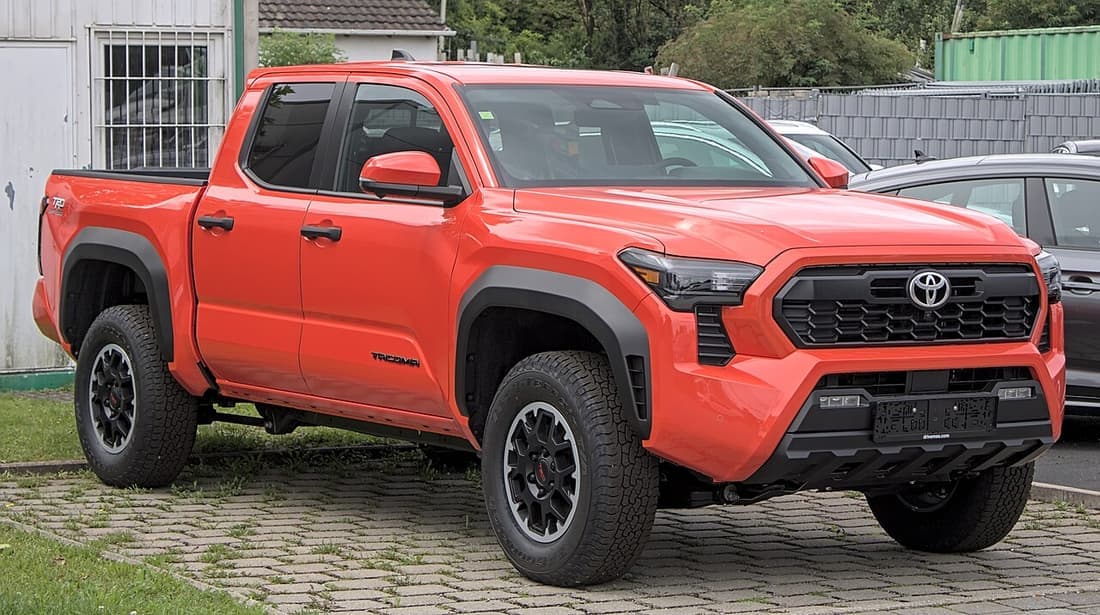
The Best Trailer Brake Controller for a Toyota Tacoma
On a mid-size truck the question is less which controller is best and more where it is going to live.
Disclosure: we earn a commission if you buy through the Amazon links on this page, at no extra cost to you. Commission never decides a verdict or a ranking position - read our editorial policy and affiliate disclosure.
How we assessed these: Assessed from each manufacturer's published specifications. Vehicle wiring differs by year, trim and factory options, and we publish no fitment data - confirm your own truck's connector and harness before buying.
Short answer
For most Tacoma owners the Tekonsha Primus IQ is the sensible hardwired choice: proportional braking in a small housing that fits a mid-size dash. If there is nowhere to mount anything, the CURT Echo plugs into the 7-way connector instead and is controlled from a phone.
A brake controller does one job - it tells the trailer's electric brakes how hard to brake, in proportion to how hard you are braking - and the hardware differences that matter on a mid-size truck are mostly physical. Dash space is limited, knee room is limited, and the kick panel area that a full-size truck uses for a controller is smaller. That is the real selection problem here.
First: does your truck need one, and can it take one
Two checks before any purchase, and both take a minute in the driveway.
- Does the trailer have electric brakes? A controller only has something to control if the trailer's brakes are electrically actuated. Surge brakes on a boat trailer are hydraulic and need no controller at all. Whether you need a controller is the first question, not the last.
- What connector is on the truck? A 7-way RV blade connector carries a dedicated brake output pin; a 4-way flat does not. If your Tacoma has a 4-way flat only, the brake circuit does not exist yet and that is part of the job. The 4-pin and 7-pin comparison shows which pins do what.
Trucks fitted with a factory tow package commonly have both the 7-way connector and a wiring provision for a controller behind the dash, but that varies by year, trim and option. Look under your own dash and at your own connector rather than relying on what a model year is reputed to have - we publish no vehicle fitment data and nobody should be guessing at a brake circuit.
What to look for on a mid-size truck
- Proportional, not time-delay. A proportional controller reads the tow vehicle's deceleration and applies trailer braking to match. A time-delay unit ramps to a preset level regardless. On a lighter truck the difference in how settled the rig feels is more noticeable, not less. The two types compared sets out why.
- A housing that fits the space you actually have. Measure the spot below the steering column before you buy. Mid-size dashes have less clearance than the controller photography suggests.
- Mounting angle tolerance. Older controllers needed to be mounted within a narrow angle range. Modern units self-level across a wide range, which matters when the only available spot is awkward.
- Boost or manual override within reach. You want the manual lever reachable without looking, because the one time it matters is the moment a trailer starts to push.
- A remote-dial option if the dash is full. Putting the electronics behind the dash and only a small knob on it is a genuine solution to the space problem rather than a workaround.
Quick picks
Tap any row to jump to the full write-up. How these are chosen - and what we do and do not claim to know - is published in full on our research methodology page.
| # | Product | Best for | Our read | Price |
|---|---|---|---|---|
| 1 |  Tekonsha Primus IQ Trailer Brake Controller Best overall | One truck, one trailer | Proportional, compact, one truck one trailer | Check price on Amazon #ad Affiliate link - we publish no price; Amazon shows the current one |
| 2 |  CURT Echo Mobile Trailer Brake Controller Best with no dash space | Rental trucks and borrowed tow vehicles | Plugs into the 7-way, controlled from a phone | Check price on Amazon #ad Affiliate link - we publish no price; Amazon shows the current one |
| 3 |  REDARC Tow-Pro Elite Electric Brake Controller Best clean install | Clean dash installs and off-road towing | Remote dial, main unit hidden behind the dash | Check price on Amazon #ad Affiliate link - we publish no price; Amazon shows the current one |
| 4 |  CURT Spectrum Integrated Proportional Brake Controller Best low-profile hardwired | Multi-axle trailers | Proportional, small housing, multi-axle capable | Check price on Amazon #ad Affiliate link - we publish no price; Amazon shows the current one |
The picks in detail
1. Best overall
Tekonsha Primus IQ Trailer Brake Controller
Tekonsha · Best for one truck, one trailer
Proportional braking without the memory, the boost profiles or the big display. For one truck and one trailer, that subtraction costs you almost nothing in how the rig actually stops, which is why it stays the default recommendation for a first controller.
We have not sourced a full specification table for this model from the manufacturer’s own site at a stable address. Rather than repeat figures we cannot cite, the assessment above is limited to what the design and the maker’s published description genuinely establish.
What works
- Proportional response at a far lower price than a flagship controller
- Small enough to mount where a larger unit will not fit
- Mounts at a range of angles without needing to be level
What does not
- No per-trailer memory, so a second trailer means re-setting gain each time
- Display tells you much less when something is wrong
Skip it if
Not the one if you swap between a light utility trailer and a heavy camper - without stored settings you will eventually drive off on the wrong gain.
#ad Affiliate link - we publish no price; Amazon shows the current one
2. Best with no dash space
CURT Echo Mobile Trailer Brake Controller
CURT · Best for rental trucks and borrowed tow vehicles
Plugs into the 7-way instead of being wired under the dash, and runs from a phone app over Bluetooth. Tri-axis inertia sensing means it does not care how it sits. The trade is that your brake interface is a phone, which is a real objection and not a small one.
Published specifications
What works
- No wiring, no drilling, and it moves between vehicles in seconds
- Tri-axis sensing removes the level-mounting requirement entirely
- Ideal when the tow vehicle is not yours to modify
What does not
- The manual override lives in a phone app, which is the wrong place for it in an emergency
- Rated for one and two-axle trailers only
Skip it if
Not for a triple-axle trailer, and not for anyone who wants a physical lever they can hit without looking.
#ad Affiliate link - we publish no price; Amazon shows the current one
Raw specifications: CURT’s own page. We earn nothing on that link.
3. Best clean install
REDARC Tow-Pro Elite Electric Brake Controller
REDARC · Best for clean dash installs and off-road towing
The control head is a single knob you can mount flush in a blank switch panel, with the electronics hidden elsewhere. It switches between proportional and user-controlled modes, which matters on loose surfaces where proportional braking reads the wrong thing.
We have not sourced a full specification table for this model from the manufacturer’s own site at a stable address. Rather than repeat figures we cannot cite, the assessment above is limited to what the design and the maker’s published description genuinely establish.
What works
- Remote knob mounts into a factory switch blank instead of hanging under the dash
- User-controlled mode gives constant output where proportional sensing misreads the surface
- Electronics sit out of sight and out of the way of knees
What does not
- Two-part installation is more work than a single-box controller
- No numeric display of what it is doing
Skip it if
Not worth the extra install work if you only ever tow on sealed roads and do not care how the controller looks.
#ad Affiliate link - we publish no price; Amazon shows the current one
4. Best low-profile hardwired
CURT Spectrum Integrated Proportional Brake Controller
CURT · Best for multi-axle trailers
A hardwired proportional controller with tri-axis sensing, a tri-color LED readout and a wide axle range - up to four braked axles, or eight with the right wiring. Mounts at essentially any angle, which solves the main problem of fitting a controller to a modern dash.
Published specifications
What works
- Mounting angle is a non-issue, which widens the list of places it will fit
- Covers heavier multi-axle trailers that a basic controller will not
- LED color tells you the state at a glance without reading a number
What does not
- An LED is a far coarser diagnostic than a text display
- Still a hardwiring job with a vehicle-specific harness
Skip it if
Skip it if you want to read exact output voltage while you tow - the color band is deliberately simpler than that.
#ad Affiliate link - we publish no price; Amazon shows the current one
Raw specifications: CURT’s own page. We earn nothing on that link.
Installation on a mid-size truck
A hardwired controller needs four connections: battery power through a fuse, ground, the brake switch signal, and the output to the 7-way connector's brake pin. On a truck with a factory tow package there is often a pre-made plug behind the dash that provides all four, which turns the job into plugging in and mounting. Without that plug it is a wiring job, and the wiring is explained in full before you start cutting anything.
The full procedure, including what a correctly set rig feels like from the driver's seat, is in the gain adjustment guide. It is the step most often skipped, and a controller left at its factory setting is the most common reason people conclude their trailer brakes are weak.
If the trailer is light
Plenty of trailers towed behind a mid-size truck have no brakes at all, and state law generally sets a trailer weight above which brakes are required. If your trailer is below that threshold and has no brake assembly, a controller has nothing to operate. Check what the trailer actually has before buying anything - the brake magnets are on the backing plates behind the trailer's wheels.
Key takeaways
- Confirm the trailer has electric brakes before buying any controller.
- Check your own connector: a 7-way carries the brake pin, a 4-way does not.
- Dash space is the real constraint on a mid-size truck - measure first.
- Set the gain on a quiet road after installing, and re-set it when the load changes.
How we sourced this
Every figure on this page came from one of the following, each fetched while the page was written. Where a manufacturer or regulator does not publish a number, we say so rather than estimate it.
- CURT Echo mobile trailer brake controller - published specifications (part 51180)
- CURT Spectrum integrated proportional brake controller - published specifications (part 51170)
- CURT 7-way RV blade connector plug, trailer side - published specifications (part 58141)
- 49 CFR 571.108 (FMVSS 108) - lamps, reflective devices and associated equipment
- 49 CFR 393.70 - coupling devices and towing methods, including safety chain and cable arrangement
Common questions
- Does a Toyota Tacoma come with a brake controller?
- Some trucks are sold with a factory-integrated controller and many are not; it depends on year, trim and options. Look under the dash to the right of the steering column and check your own vehicle rather than relying on a general answer.
- Can I use a wireless brake controller on a mid-size truck?
- Yes. A unit that plugs into the 7-way connector and is operated from a phone needs no dash space and no wiring work, which is a real advantage on a smaller cab. The trade is that the control surface is a screen rather than a lever you can reach without looking.
- Do I need a brake controller for a small utility trailer?
- Only if the trailer has electric brakes. Many light utility trailers have none, and a controller cannot create braking that is not there. Check the backing plates behind the trailer wheels.
- Will a brake controller work through a 4-pin to 7-pin adapter?
- Only if the vehicle side genuinely has a brake output. An adapter rearranges existing circuits; it cannot add one that the truck does not provide. A 4-way flat has no brake pin, so there is nothing for the adapter to pass through.
More in Trailer Brake Controllers
If the trailer has electric brakes, something has to tell them how hard to work. That something is a controller, and how you set it decides how the rig stops.
Read next
Best brake controller
Best Brake Controllers
Hardwired and plug-in proportional controllers compared on published specifications and how each behaves when something goes wrong.
Guide
Do I Need a Brake Controller?
A decision path covering unbraked, surge-brake and electric-brake trailers, plus what to check on your tow vehicle first.
Head to head
Proportional vs Time-Delay
How each type decides output, what each feels like from the driver's seat, and why time-delay is now mostly a legacy choice.
How to
Adjusting Brake Gain
The empirical gain procedure, how to read under- and over-braking, and the loads that make a reset necessary.
Found something out of date, or a figure you can source better than we did? Corrections get read first. How we research explains how these pages are put together, and contact is one click away.