Weight Distribution Hitches
Do I Need a Weight Distribution Hitch?
It is a number, not a judgment call. Two labels and one measurement settle it in about twenty minutes.

Disclosure: we earn a commission if you buy through the Amazon links on this page, at no extra cost to you. Commission never decides a verdict or a ranking position - read our editorial policy and affiliate disclosure.
Short answer
You need one if your measured loaded tongue weight exceeds the receiver's weight-carrying rating, or if the front of the tow vehicle rises noticeably when you hitch up. If neither is true, you do not need one.
Check one: your receiver's two ratings
Look at the label on the receiver itself. It carries two sets of numbers: weight-carrying and weight-distributing. The weight-carrying rating is what the receiver may handle with a plain ball mount. The weight-distributing rating is higher and only applies when a weight distribution hitch is actually fitted.
If your tongue weight exceeds the weight-carrying rating, the hitch is not an upgrade - it is the condition under which your receiver is rated to carry that load at all.
Check two: measure the tongue weight
Loaded, the way you actually tow. Not the dry figure from the trailer's brochure, which excludes propane, batteries, water and everything you put inside. The measuring methods are here and the cheapest needs nothing but a public scale.
Check three: the fender test
The twenty-minute test
Park level and unhitched
Tow vehicle on flat ground, trailer not connected.
Measure both fender arches
Ground to the top of the front wheel arch, and the same at the rear. Write both down.
Hitch up with a plain ball mount
Trailer loaded as you would actually tow it.
Measure both arches again
The rear will have dropped. The question is what happened at the front.
Read the result
If the front arch rose by more than roughly an inch, you are unloading the front axle enough to affect steering and braking. That is a weight distribution case regardless of what the ratings say.
When the answer is no
- Tongue weight comfortably inside the weight-carrying rating and the truck stays level. Save the money.
- Fifth wheel or gooseneck. The load sits ahead of the rear axle, so there is no lever to counteract. Weight distribution does not apply.
- The trailer manufacturer prohibits it. Some pop-ups and boat trailers do. That restriction overrides everything.
- Small utility or boat trailer under a few thousand pounds behind a full-size truck. Almost never needed.
Quick picks
Tap any row to jump to the full write-up. How these are chosen - and what we do and do not claim to know - is published in full on our research methodology page.
| # | Product | Best for | Our read | Price |
|---|---|---|---|---|
| 1 |  Sherline Trailer Tongue Weight Scale Start here | Measuring tongue weight at home | The measurement the question depends on | Check price on Amazon #ad Affiliate link - we publish no price; Amazon shows the current one |
| 2 |  Equal-i-zer 4-point Sway Control Hitch If the answer is yes | Travel trailers that already sway | Load transfer plus always-on sway resistance | Check price on Amazon #ad Affiliate link - we publish no price; Amazon shows the current one |
| 3 |  CURT Round Bar Weight Distribution Hitch with Sway Control (14K) Value option if yes | Mid-size travel trailers | 14,000 lb gross, integrated lubrication | Check price on Amazon #ad Affiliate link - we publish no price; Amazon shows the current one |
1. Start here
Sherline Trailer Tongue Weight Scale
Sherline · Best for measuring tongue weight at home
A dedicated scale you sit under the coupler to read tongue weight directly, with no arithmetic and no trip to a weighbridge. It is the one tool on this site that turns the single most important towing number from a guess into a measurement.
We have not sourced a full specification table for this model from the manufacturer’s own site at a stable address. Rather than repeat figures we cannot cite, the assessment above is limited to what the design and the maker’s published description genuinely establish.
What works
- Direct reading, with no bathroom-scale-and-lever arithmetic
- Repeatable, so you can see what moving the load actually does
- Mechanical gauge with no batteries to be flat when you need it
What does not
- Must be used on level ground with the coupler at towing height
- Single-purpose tool that spends most of its life in a cupboard
Skip it if
Unnecessary if your hitch already has a built-in gauge, or if you have a public scale nearby and are happy to use it.
#ad Affiliate link - we publish no price; Amazon shows the current one
Raw specifications: Sherline’s own page. We earn nothing on that link.
2. If the answer is yes
Equal-i-zer 4-point Sway Control Hitch
Equal-i-zer · Best for travel trailers that already sway
The reference point for integrated sway control. Friction happens at four places at once - both L-brackets and both sockets - so resistance is always on rather than something you remember to engage. Setup is bracket-height and bar-angle work, and it rattles; both are the price of a system with no separate parts to forget.
We have not sourced a full specification table for this model from the manufacturer’s own site at a stable address. Rather than repeat figures we cannot cite, the assessment above is limited to what the design and the maker’s published description genuinely establish.
What works
- Sway resistance is built into the geometry, so there is nothing to connect or disconnect at the ramp
- Works in reverse and in the wet, unlike a friction bar you have to release
- One assembly rather than a hitch plus a bolt-on sway bar
What does not
- Audible rattle and creak at low speed is normal and surprises first-time owners
- Bracket height and bar angle have to be set properly or the sway control does little
Skip it if
Skip it if your loaded tongue weight sits well inside your receiver's weight-carrying rating and the truck stays level - you would be buying hardware to solve a problem you do not have.
#ad Affiliate link - we publish no price; Amazon shows the current one
Raw specifications: Equal-i-zer’s own page. We earn nothing on that link.
3. Value option if yes
CURT Round Bar Weight Distribution Hitch with Sway Control (14K)
CURT · Best for mid-size travel trailers
A conventional round-bar system with integrated lubrication and sway control, rated to 14,000 lb gross and 1,400 lb tongue. The built-in lubrication matters more than it sounds: a dry weight distribution head is the usual source of the groaning people mistake for a failing hitch.
Published specifications
What works
- Integrated lubrication at the head, which is where the noise usually comes from
- Round bars sit lower and clear more trailer tongues than trunnion bars
- Limited lifetime warranty
What does not
- Round bars hang lower than trunnion bars and are the first thing to catch on a steep driveway
- Sway control here is a function of the head, not an adjustable four-point system
Skip it if
Skip it if you regularly cross steep transitions - a round bar is the lowest part of the whole rig and will find the pavement before anything else does.
#ad Affiliate link - we publish no price; Amazon shows the current one
Raw specifications: CURT’s own page. We earn nothing on that link.
Key takeaways
- Compare measured tongue weight against the receiver's weight-carrying rating - that is the primary test.
- A front fender that rises more than about an inch is a weight distribution case on its own.
- Fifth wheels, goosenecks and some specific trailers are excluded entirely.
- No symptoms and ratings in hand means no purchase needed.
How we sourced this
Every figure on this page came from one of the following, each fetched while the page was written. Where a manufacturer or regulator does not publish a number, we say so rather than estimate it.
- 49 CFR 567.4 - certification label content, including Gross Vehicle Weight Rating and Gross Axle Weight Rating
- 49 CFR 571.110 (FMVSS 110) - vehicle placard, including the required "combined weight of occupants and cargo" statement
- CURT round bar weight distribution hitch with sway control - published specifications (part 17063)
Common questions
- Where is the receiver's rating label?
- On the receiver itself, usually a sticker or stamped plate on the crossmember near the tube. It lists weight-carrying and, where applicable, weight-distributing figures.
- My trailer is under the tow rating. Is that enough?
- No. Tow rating is about the powertrain and brakes. Tongue weight against the receiver's carrying rating, and against payload, are separate limits and usually the binding ones.
- Is it illegal to tow without one if I am over the carrying rating?
- Enforcement varies by state, but exceeding a component rating is exceeding a manufacturer limit, with the liability and insurance consequences that implies. Treat the rating as the answer regardless of enforcement.
More in Weight Distribution Hitches
A weight distribution hitch moves load off the back of your truck. Whether you need one is a number, not an opinion - and the number is on your door jamb.
Read next

Head to head
Weight Distribution vs Sway Control
The clearest distinction in towing, explained by symptom: squatting truck versus wandering trailer, and what to do when it is both.

How to
Measuring Tongue Weight
Three methods for measuring tongue weight, what each one requires, and how to interpret the result against the 10-15 percent band.

Troubleshooting
Truck Sags When Towing
What rear squat actually indicates, why it affects steering and braking, and which of the three common fixes addresses the real problem.
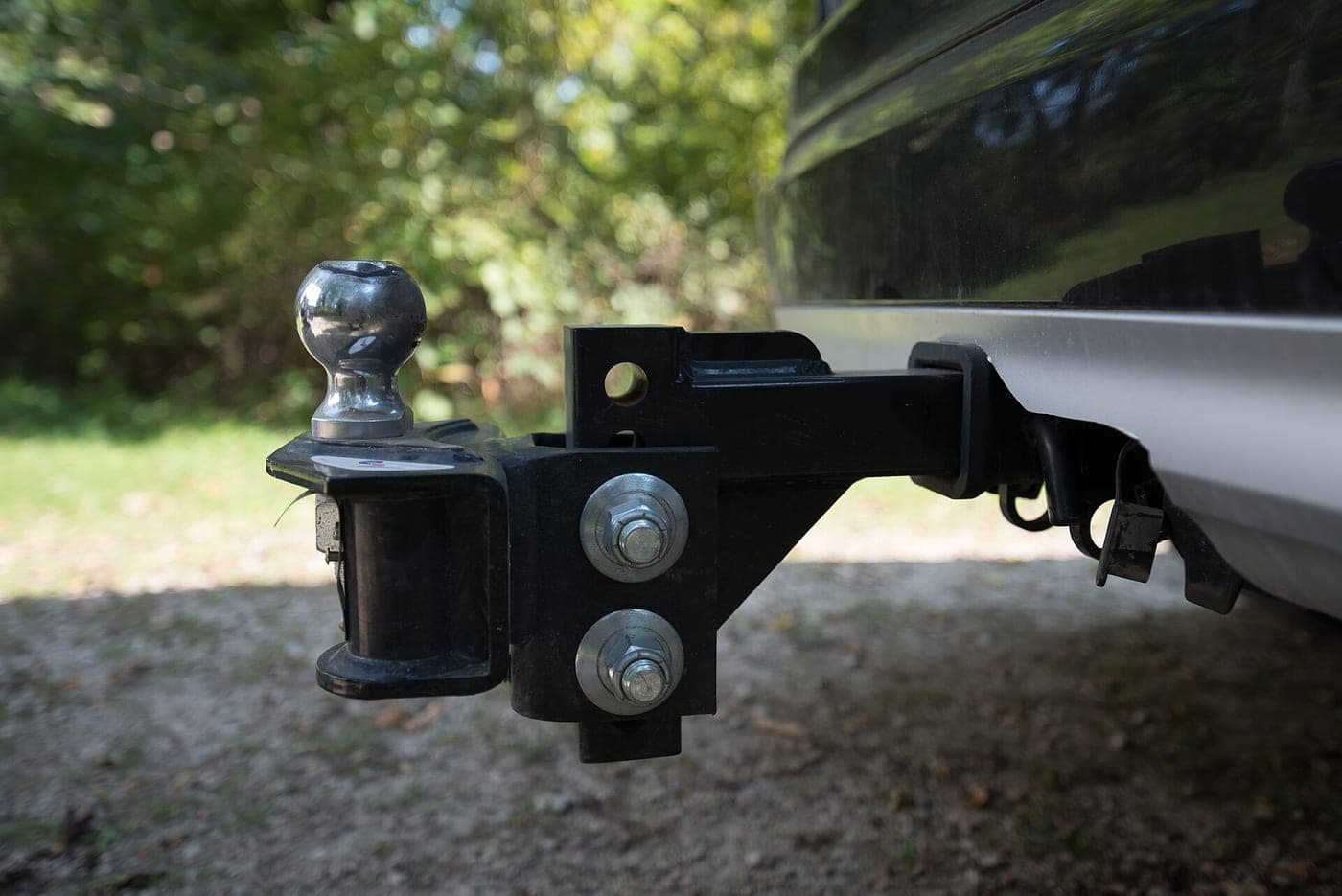
Best WD hitch overall
Best WD Hitch with Sway Control
Integrated sway control plus load transfer, compared on bar sizing granularity, ground clearance and how hard they are to set up alone.
Found something out of date, or a figure you can source better than we did? Corrections get read first. How we research explains how these pages are put together, and contact is one click away.