Nearly every trailer electrical fault is corrosion or a bad ground. Knowing which wire does what turns a roadside mystery into a five-minute check.
Trailer electrics have a bad reputation they mostly do not deserve. The circuits are simple, the standard connectors have been the same for decades, and the overwhelming majority of faults come down to two things: a corroded contact or a bad ground. Once you know which wire does what, diagnosis takes minutes rather than an afternoon.
Two connectors cover almost everything
What each connector carries
Connector
Circuits
Typical use
4-way flat
Ground, tail/running lights, left turn and brake, right turn and brake
Small utility trailers, light boat trailers, bike racks - lighting only
7-way RV blade
The four above, plus electric brakes, a 12V auxiliary feed and reverse
Travel trailers, horse trailers, anything with electric brakes
That table contains the single most useful fact in this category: a 4-way has no brake circuit. No adapter can create one. If your trailer has electric brakes and your truck only has a 4-way, you do not need an adapter - you need a 7-way installed. People buy the adapter, find the brakes do not work, and conclude the adapter is faulty. It is not; the wire simply is not there.
Why lights fail, in order of likelihood
1Ground. The trailer's ground returns through the white wire and, on many trailers, through the frame itself. A rusty bolt where the ground strap meets the frame is the single most common cause of lights that are dim, flicker, or cross over - brake lights that make the turn signal come on are a textbook ground fault, not a wiring mix-up.
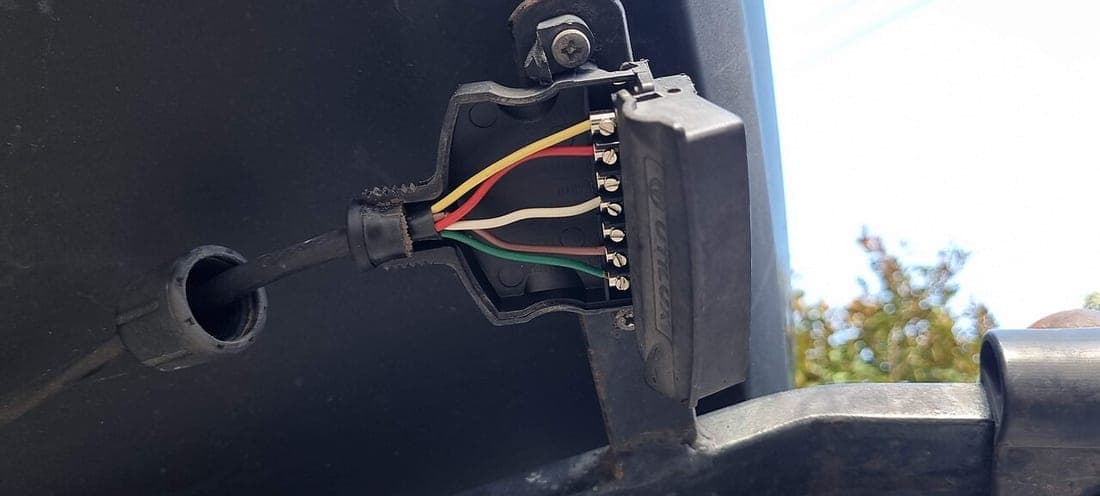
2Connector corrosion. The plug lives behind a vehicle, outside, through winters. Green contacts are normal. A replacement trailer-side plug costs little and solves a surprising share of intermittent faults.
3Bulb or lamp failure. Still happens, but on a modern sealed LED lamp it is far less common than it used to be.
4Damaged run. A wire chafed through where it crosses the frame or got caught on something at the ramp. Last on the list because it is the rarest, and the first thing people assume.
Wiring the vehicle: harness, not splices
Modern vehicles should get a vehicle-specific harness that plugs into existing factory connectors behind the tail lights. It is reversible, it does not cut anything, and it avoids the voltage-drop problems that come from clamp-on splice connectors. The entire job is buying the right part number for your exact year, model and trim - get that wrong and you end up cutting wires you never needed to touch.
Mirrors: the law is about seeing, not about mirrors
If your trailer is wider than your tow vehicle, your factory mirrors show you the side of the trailer and nothing else. Most states phrase their requirement in terms of being able to see a set distance behind you, rather than mandating a particular mirror, which means the practical test is simple: can you see the lane behind the trailer, or not?
Clip-on extensions strap over the existing mirror. Cheap, universal, removable - and they vibrate at highway speed, which is the honest limitation of every one of them.
Replacement towing mirrors are built for a specific vehicle and usually telescope or extend. They stay aligned trip after trip and do not vibrate, at the cost of being vehicle-specific and permanent.
Add-on convex spots are a few dollars and genuinely useful regardless of which of the above you choose, because they cover the blind spot alongside a long trailer.
The mistake buyers make
Replacing parts in the wrong order. The sequence that saves money is: check the ground, then the connector, then the lamps, then the run. Most people start by buying a new light kit. The second mistake is buying the smallest clip-on mirror that looks tidy - if the trailer is genuinely wide, a mirror that does not reach past it has solved nothing.
How we sourced this
Every figure on this page came from one of the following, each fetched while the page was written. Where a manufacturer or regulator does not publish a number, we say so rather than estimate it.
4-way and 7-way color conventions side by side, with the honest caveat about aftermarket wiring and how to verify.
Read it →
Common questions
Can I use an adapter to run electric brakes from a 4-pin?
No. A 4-way flat carries ground, running lights and the two turn/brake circuits - there is no brake output and no 12V feed. Running electric brakes needs a 7-way and a brake controller.
My brake lights make the turn signals flash. What is wrong?
Almost always a bad ground. When the ground path is poor, current finds a return through another circuit, which produces exactly this cross-talk. Clean the ground connection at the trailer frame before replacing anything.
Do I legally need towing mirrors?
Most states require a given rearward field of view rather than a specific mirror, and the requirements differ state to state. The practical standard is whether you can see the lane behind your trailer. If the trailer is wider than the tow vehicle, you almost certainly need extensions.
Are LED trailer lights worth fitting to an old trailer?
Usually yes. They draw less current, which is kinder to tired wiring and a marginal ground, and sealed units have no bulb sockets to corrode. They will not compensate for a bad ground, though - fix that first or you will blame the new lamps.