Trailer Brake Controllers
Do I Need a Trailer Brake Controller?
Two questions, in order: does the trailer have brakes, and are they electric? Everything follows from those.

Disclosure: we earn a commission if you buy through the Amazon links on this page, at no extra cost to you. Commission never decides a verdict or a ranking position - read our editorial policy and affiliate disclosure.
Short answer
You need a brake controller only if your trailer has electric brakes. Unbraked trailers and surge-brake (hydraulic) trailers do not use one. Most states require brakes above a weight threshold, and those thresholds vary.
The decision path
Three questions
Does the trailer have brakes at all?
Look behind the wheels for a backing plate and a drum, and look for a wire running along the frame to each wheel. No brakes means no controller - and possibly a legal problem if the trailer is above your state's threshold.
Are they electric or surge?
Electric brakes have wiring to each wheel and need a 7-way connection. Surge brakes have a hydraulic actuator built into the coupler - the coupler slides as the trailer pushes. Surge needs no controller.
Does the tow vehicle already have a controller?
Many modern trucks with a tow package have one integrated, with gain in the dash menu. If so, you are done - and you must not add a second.
What the law generally requires
Brake requirements for private trailers are set by state, and the weight thresholds differ substantially between them. We are not going to publish a state table we cannot verify and keep current - check your own state's requirement directly, and remember that the state you are driving through matters as well as the state you registered in.
What is consistent is the underlying idea: above a certain trailer weight, the tow vehicle's brakes alone are not considered adequate. Federal rules for commercial towing spell out equivalent principles in 49 CFR 393, including the requirement that a towed vehicle's braking system be operable from the towing vehicle in defined circumstances.
When a controller is worth having even if not required
- Mountain towing. Long descents are where trailer brakes stop being a formality.
- A trailer near the top of your tow rating. Stopping distance grows faster than most people expect.
- Sway risk. The manual override is the one input that reliably pulls a swaying trailer straight.
- Wet weather. Trailer braking distributes the work across more tires rather than loading the tow vehicle's.
Quick picks
Tap any row to jump to the full write-up. How these are chosen - and what we do and do not claim to know - is published in full on our research methodology page.
| # | Product | Best for | Our read | Price |
|---|---|---|---|---|
| 1 |  Tekonsha Primus IQ Trailer Brake Controller If the answer is yes | One truck, one trailer | Proportional, simple, well supported | Check price on Amazon #ad Affiliate link - we publish no price; Amazon shows the current one |
| 2 |  CURT Echo Mobile Trailer Brake Controller If the vehicle is not yours | Rental trucks and borrowed tow vehicles | No wiring, moves between trucks | Check price on Amazon #ad Affiliate link - we publish no price; Amazon shows the current one |
| 3 |  CURT 4-Way to 5-Way Flat Adapter for Surge Brakes If the trailer has surge brakes | Boat trailers with surge brakes | Reverse lockout, not a controller | Check price on Amazon #ad Affiliate link - we publish no price; Amazon shows the current one |
1. If the answer is yes
Tekonsha Primus IQ Trailer Brake Controller
Tekonsha · Best for one truck, one trailer
Proportional braking without the memory, the boost profiles or the big display. For one truck and one trailer, that subtraction costs you almost nothing in how the rig actually stops, which is why it stays the default recommendation for a first controller.
We have not sourced a full specification table for this model from the manufacturer’s own site at a stable address. Rather than repeat figures we cannot cite, the assessment above is limited to what the design and the maker’s published description genuinely establish.
What works
- Proportional response at a far lower price than a flagship controller
- Small enough to mount where a larger unit will not fit
- Mounts at a range of angles without needing to be level
What does not
- No per-trailer memory, so a second trailer means re-setting gain each time
- Display tells you much less when something is wrong
Skip it if
Not the one if you swap between a light utility trailer and a heavy camper - without stored settings you will eventually drive off on the wrong gain.
#ad Affiliate link - we publish no price; Amazon shows the current one
2. If the vehicle is not yours
CURT Echo Mobile Trailer Brake Controller
CURT · Best for rental trucks and borrowed tow vehicles
Plugs into the 7-way instead of being wired under the dash, and runs from a phone app over Bluetooth. Tri-axis inertia sensing means it does not care how it sits. The trade is that your brake interface is a phone, which is a real objection and not a small one.
Published specifications
What works
- No wiring, no drilling, and it moves between vehicles in seconds
- Tri-axis sensing removes the level-mounting requirement entirely
- Ideal when the tow vehicle is not yours to modify
What does not
- The manual override lives in a phone app, which is the wrong place for it in an emergency
- Rated for one and two-axle trailers only
Skip it if
Not for a triple-axle trailer, and not for anyone who wants a physical lever they can hit without looking.
#ad Affiliate link - we publish no price; Amazon shows the current one
Raw specifications: CURT’s own page. We earn nothing on that link.
3. If the trailer has surge brakes
CURT 4-Way to 5-Way Flat Adapter for Surge Brakes
CURT · Best for boat trailers with surge brakes
The small adapter that lets a 4-way vehicle feed a boat trailer with surge brakes, which need a fifth wire to disable the brakes while reversing. Specific, unglamorous, and the difference between backing down a ramp and fighting the trailer's own brakes.
Published specifications
What works
- Solves the reverse-lockout problem without rewiring the vehicle
- Small enough to live in the glovebox as a spare
- Standard connector shapes on both ends
What does not
- Only relevant to surge-brake trailers
- Another connection in the circuit, and connections are what corrode
Skip it if
Irrelevant to electric trailer brakes - those need a 7-way and a brake controller, not an adapter.
#ad Affiliate link - we publish no price; Amazon shows the current one
Raw specifications: CURT’s own page. We earn nothing on that link.
Key takeaways
- Controllers are for electric brakes only.
- Surge brakes are hydraulic and self-actuating - no controller, sometimes a reverse lockout.
- Check for a factory controller before buying one.
- State requirements vary; check yours and the ones you drive through.
How we sourced this
Every figure on this page came from one of the following, each fetched while the page was written. Where a manufacturer or regulator does not publish a number, we say so rather than estimate it.
Common questions
- How do I know if my trailer has electric brakes?
- Look for a wire running to each braked wheel and a 7-way plug on the trailer. A 4-way flat plug means no brake circuit, so the trailer cannot have electric brakes connected.
- What about surge brakes?
- They actuate hydraulically when the trailer pushes against the coupler, and need no controller. Some need a reverse lockout circuit so the brakes release when you back up, which is what a 4-way to 5-way adapter provides.
- Can I tow a braked trailer without a controller?
- The brakes will simply not work, which means your tow vehicle is stopping everything alone. Depending on the trailer's weight and your state, it may also be unlawful.
More in Trailer Brake Controllers
If the trailer has electric brakes, something has to tell them how hard to work. That something is a controller, and how you set it decides how the rig stops.
Read next
Best brake controller
Best Brake Controllers
Hardwired and plug-in proportional controllers compared on published specifications and how each behaves when something goes wrong.

How to
Install a Brake Controller
The installation sequence with the four circuits explained, plus the verification steps that matter before the first tow.
Head to head
4-Pin vs 7-Pin
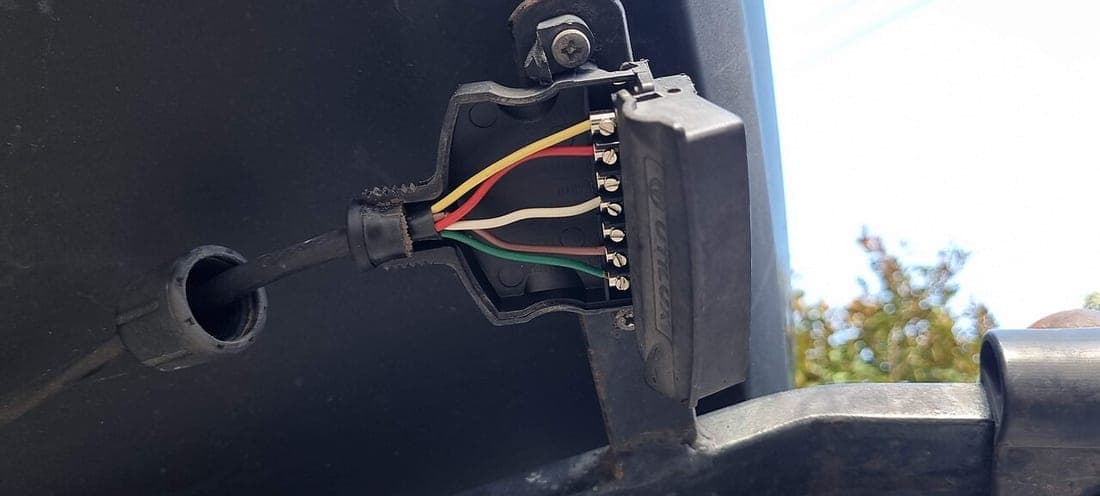
What each connector carries, why adapters cannot add circuits, and when upgrading a vehicle to a 7-way is the real answer.
Troubleshooting
Trailer Brakes Not Working
An ordered diagnostic sequence for electric trailer brakes, from the connector outward, with the checks that need no tools.
Found something out of date, or a figure you can source better than we did? Corrections get read first. How we research explains how these pages are put together, and contact is one click away.