Wiring, Lights & Towing Mirrors
4-Pin vs 7-Pin Trailer Connectors
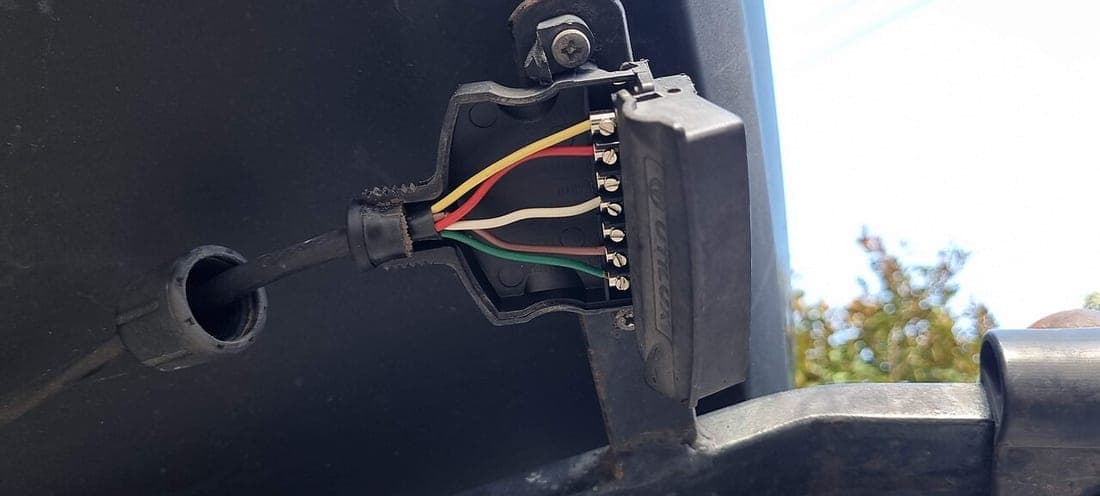
The difference is three extra conductors - brakes, 12V and reverse - and no adapter can conjure them from nowhere.
Disclosure: we earn a commission if you buy through the Amazon links on this page, at no extra cost to you. Commission never decides a verdict or a ranking position - read our editorial policy and affiliate disclosure.
Short answer
A 4-way flat carries ground, running lights, left turn/brake and right turn/brake - lighting only. A 7-way RV blade adds electric brakes, a 12V auxiliary feed and reverse. No adapter can add circuits the connector does not physically contain.
What each one carries
| Circuit | 4-way flat | 7-way RV blade |
|---|---|---|
| Ground | Yes | Yes |
| Tail / running lights | Yes | Yes |
| Left turn and brake | Yes | Yes |
| Right turn and brake | Yes | Yes |
| Electric trailer brakes | No | Yes |
| 12V auxiliary / charge line | No | Yes |
| Reverse | No | Yes |
Which direction the adapter works
- 7-way vehicle to 4-way trailer. Works properly. The lighting circuits map across, and the unused circuits simply go nowhere. This is the common case - a big truck pulling a small trailer.
- 4-way vehicle to 7-way trailer. Lighting works. Brakes do not. The 12V feed does not. If the trailer needs any of those, the vehicle needs a real 7-way installation.
Upgrading a vehicle from 4-way to 7-way
It is a bigger job than swapping a socket. The lighting conductors already exist; the brake output, the 12V feed and reverse do not. Those run from the front of the vehicle, with the 12V feed fused at the battery and the brake output coming from a controller you also need to install. Budget for a harness, a controller, a fused feed and a socket bracket.
Quick picks
Tap any row to jump to the full write-up. How these are chosen - and what we do and do not claim to know - is published in full on our research methodology page.
| # | Product | Best for | Our read | Price |
|---|---|---|---|---|
| 1 |  CURT 7-Way RV Blade Connector Plug (trailer side) 7-way replacement | Replacing a corroded trailer plug | Trailer-side plug, screw terminals | Check price on Amazon #ad Affiliate link - we publish no price; Amazon shows the current one |
| 2 |  Hopkins 7-Blade to 4-Wire Flat Adapter Adapter, lighting only | Pulling a small trailer with a big truck | Big truck to small trailer | Check price on Amazon #ad Affiliate link - we publish no price; Amazon shows the current one |
| 3 |  CURT Custom Vehicle-to-Trailer Wiring Harness (T-connector) The proper upgrade | Adding trailer wiring without splicing | Plug-in vehicle wiring | Check price on Amazon #ad Affiliate link - we publish no price; Amazon shows the current one |
1. 7-way replacement
CURT 7-Way RV Blade Connector Plug (trailer side)
CURT · Best for replacing a corroded trailer plug
The trailer-side plug for a standard 7-way RV blade connection. Replacing a corroded plug is a twenty-minute job and fixes a surprising share of intermittent light and brake faults - far more often than the fault is actually in the truck.
Published specifications
What works
- Cheap, standard part that cures a lot of intermittent faults
- Screw terminals, so no special crimping tool is needed
- Fits the standard 7-way RV pattern used across the US
What does not
- Only the trailer half - a corroded vehicle socket needs the other part
- Short one-year warranty compared with CURT's structural parts
Skip it if
Not the part you need if your trailer uses a 4-way flat - check which connector you actually have before ordering anything.
#ad Affiliate link - we publish no price; Amazon shows the current one
Raw specifications: CURT’s own page. We earn nothing on that link.
2. Adapter, lighting only
Hopkins 7-Blade to 4-Wire Flat Adapter
Hopkins Towing Solutions · Best for pulling a small trailer with a big truck
Lets a truck with a 7-way socket pull a trailer with a 4-way flat plug. It passes lighting through and nothing else - no brakes, no charge line - which is exactly what people misunderstand about adapters.
We have not sourced a full specification table for this model from the manufacturer’s own site at a stable address. Rather than repeat figures we cannot cite, the assessment above is limited to what the design and the maker’s published description genuinely establish.
What works
- Keeps one truck able to tow both connector types
- Costs almost nothing and lives in the glovebox
- No wiring work at either end
What does not
- Carries lighting only - electric brakes and the charge line do not pass through
- Hanging adapters strain the socket if left in permanently
Skip it if
Do not use it to tow a braked trailer - the brake circuit is simply not present in a 4-way, and an adapter cannot invent one.
#ad Affiliate link - we publish no price; Amazon shows the current one
3. The proper upgrade
CURT Custom Vehicle-to-Trailer Wiring Harness (T-connector)
CURT · Best for adding trailer wiring without splicing
A vehicle-specific harness that plugs into existing factory connectors instead of splicing into tail light wiring. Buying the right one for your exact year and model is the whole job; getting that wrong is why people end up cutting wires they did not need to cut.
We have not sourced a full specification table for this model from the manufacturer’s own site at a stable address. Rather than repeat figures we cannot cite, the assessment above is limited to what the design and the maker’s published description genuinely establish.
What works
- Plugs into factory connectors, so nothing is cut and nothing is taped
- Reversible - the vehicle goes back to standard in minutes
- Avoids the voltage problems that come with scotch-lock splices
What does not
- Vehicle-specific, so the part number must match year, model and trim
- Some vehicles need a separate power feed the harness does not supply
Skip it if
Not the part for a trailer needing electric brakes - that is a 7-way install with a brake controller feed, which a lighting harness does not cover.
#ad Affiliate link - we publish no price; Amazon shows the current one
Raw specifications: CURT’s own page. We earn nothing on that link.
Key takeaways
- 4-way is lighting only; 7-way adds brakes, 12V and reverse.
- Adapters convert shape, not capability.
- 7-way vehicle to 4-way trailer is fine; the reverse is limited to lighting.
- A genuine 7-way upgrade means new conductors, a fused feed and a controller.
How we sourced this
Every figure on this page came from one of the following, each fetched while the page was written. Where a manufacturer or regulator does not publish a number, we say so rather than estimate it.
Common questions
- Can I use an adapter and a brake controller together?
- Only if the vehicle socket is a 7-way. A controller needs the brake conductor to reach the trailer, and a 4-way vehicle socket has nowhere to send it.
- What is the 12V pin for?
- Charging a trailer battery and powering interior equipment on a camper. It also feeds the breakaway battery charger on trailers that have one.
- Is a 5-way flat a thing?
- Yes - a 4-way plus a fifth conductor used for the reverse lockout on surge-brake trailers, so the brakes release when backing up. Adapters exist specifically for this.
More in Wiring, Lights & Towing Mirrors
Nearly every trailer electrical fault is corrosion or a bad ground. Knowing which wire does what turns a roadside mystery into a five-minute check.
Read next
Reference
7-Pin Wiring Diagram
The seven circuits and what each one does, the common color convention, and how to confirm it on your own vehicle.
Guide
4-Pin to 7-Pin Adapters
What adapters genuinely solve, the direction that works, and why the brake circuit cannot be adapted into existence.
Guide
Do I Need a Brake Controller?
A decision path covering unbraked, surge-brake and electric-brake trailers, plus what to check on your tow vehicle first.
Best wiring harness
Best Wiring Harnesses
Vehicle-specific harnesses, replacement plugs and adapters - what each is for and which part fails first.
Found something out of date, or a figure you can source better than we did? Corrections get read first. How we research explains how these pages are put together, and contact is one click away.