Wiring, Lights & Towing Mirrors
7-Pin Trailer Wiring: Functions and Colors
Seven circuits, one connector, and a color convention that is widely followed and still worth verifying on your own trailer.
Disclosure: we earn a commission if you buy through the Amazon links on this page, at no extra cost to you. Commission never decides a verdict or a ranking position - read our editorial policy and affiliate disclosure.
Short answer
A 7-way RV blade connector carries ground, tail/running lights, left turn and brake, right turn and brake, electric brakes, a 12V auxiliary feed and reverse. Colors follow a widely used convention which you should confirm with a test light before relying on it.
The seven circuits
| Function | Conventional color | What it does |
|---|---|---|
| Ground | White | Return path for every other circuit |
| Tail and running lights | Brown | Marker, clearance and tail lamps |
| Left turn and brake | Yellow | Left side turn signal and stop lamp |
| Right turn and brake | Green | Right side turn signal and stop lamp |
| Electric brakes | Blue | Variable output from the brake controller |
| 12V auxiliary | Black | Battery charge line and accessory power |
| Reverse | Purple | Backup lamps, or surge brake lockout |
Colors are the common convention. Verify with a test light on your own vehicle and trailer - aftermarket wiring frequently differs.
How to verify in ten minutes
With a test light and a helper
Clip the test light to a known-good ground
Bare metal on the vehicle, not a painted surface.
Turn on the running lights
Probe each pin in the vehicle socket. The one that lights is your tail/running circuit.
Have the helper press the brake pedal
Two pins should light - the left and right stop/turn circuits.
Signal left, then right
Each one identifies which of those two pins is which side.
Select reverse
Identifies the reverse circuit. On some vehicles this pin is not connected at all.
Apply the brake controller's manual override
The brake output pin should show voltage rising with gain. A multimeter is better than a test light here.
What is left is 12V and ground
The 12V pin is live permanently; ground is the one that makes everything else work.
Quick picks
Tap any row to jump to the full write-up. How these are chosen - and what we do and do not claim to know - is published in full on our research methodology page.
| # | Product | Best for | Our read | Price |
|---|---|---|---|---|
| 1 |  CURT 7-Way RV Blade Connector Plug (trailer side) Replacement plug | Replacing a corroded trailer plug | Screw terminals, no crimping tool needed | Check price on Amazon #ad Affiliate link - we publish no price; Amazon shows the current one |
| 2 |  CURT Custom Vehicle-to-Trailer Wiring Harness (T-connector) Vehicle side | Adding trailer wiring without splicing | Factory connectors, nothing cut | Check price on Amazon #ad Affiliate link - we publish no price; Amazon shows the current one |
| 3 |  Hopkins 7-Blade to 4-Wire Flat Adapter When the trailer is 4-way | Pulling a small trailer with a big truck | Lighting passes, brakes do not | Check price on Amazon #ad Affiliate link - we publish no price; Amazon shows the current one |
1. Replacement plug
CURT 7-Way RV Blade Connector Plug (trailer side)
CURT · Best for replacing a corroded trailer plug
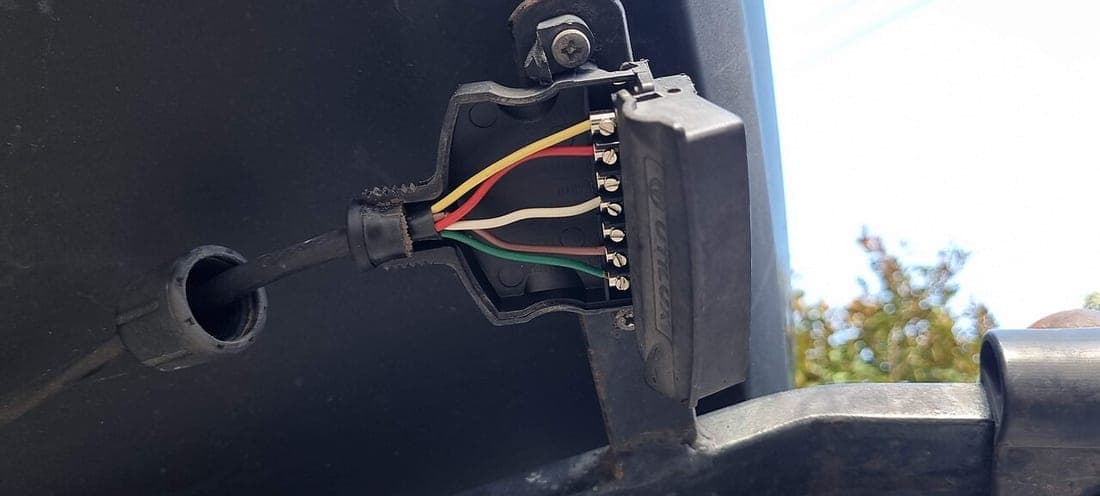
The trailer-side plug for a standard 7-way RV blade connection. Replacing a corroded plug is a twenty-minute job and fixes a surprising share of intermittent light and brake faults - far more often than the fault is actually in the truck.
Published specifications
What works
- Cheap, standard part that cures a lot of intermittent faults
- Screw terminals, so no special crimping tool is needed
- Fits the standard 7-way RV pattern used across the US
What does not
- Only the trailer half - a corroded vehicle socket needs the other part
- Short one-year warranty compared with CURT's structural parts
Skip it if
Not the part you need if your trailer uses a 4-way flat - check which connector you actually have before ordering anything.
#ad Affiliate link - we publish no price; Amazon shows the current one
Raw specifications: CURT’s own page. We earn nothing on that link.
2. Vehicle side
CURT Custom Vehicle-to-Trailer Wiring Harness (T-connector)
CURT · Best for adding trailer wiring without splicing
A vehicle-specific harness that plugs into existing factory connectors instead of splicing into tail light wiring. Buying the right one for your exact year and model is the whole job; getting that wrong is why people end up cutting wires they did not need to cut.
We have not sourced a full specification table for this model from the manufacturer’s own site at a stable address. Rather than repeat figures we cannot cite, the assessment above is limited to what the design and the maker’s published description genuinely establish.
What works
- Plugs into factory connectors, so nothing is cut and nothing is taped
- Reversible - the vehicle goes back to standard in minutes
- Avoids the voltage problems that come with scotch-lock splices
What does not
- Vehicle-specific, so the part number must match year, model and trim
- Some vehicles need a separate power feed the harness does not supply
Skip it if
Not the part for a trailer needing electric brakes - that is a 7-way install with a brake controller feed, which a lighting harness does not cover.
#ad Affiliate link - we publish no price; Amazon shows the current one
Raw specifications: CURT’s own page. We earn nothing on that link.
3. When the trailer is 4-way
Hopkins 7-Blade to 4-Wire Flat Adapter
Hopkins Towing Solutions · Best for pulling a small trailer with a big truck
Lets a truck with a 7-way socket pull a trailer with a 4-way flat plug. It passes lighting through and nothing else - no brakes, no charge line - which is exactly what people misunderstand about adapters.
We have not sourced a full specification table for this model from the manufacturer’s own site at a stable address. Rather than repeat figures we cannot cite, the assessment above is limited to what the design and the maker’s published description genuinely establish.
What works
- Keeps one truck able to tow both connector types
- Costs almost nothing and lives in the glovebox
- No wiring work at either end
What does not
- Carries lighting only - electric brakes and the charge line do not pass through
- Hanging adapters strain the socket if left in permanently
Skip it if
Do not use it to tow a braked trailer - the brake circuit is simply not present in a 4-way, and an adapter cannot invent one.
#ad Affiliate link - we publish no price; Amazon shows the current one
Where the circuit normally fails
At the connector, and at the trailer's frame ground. Those two account for most faults in this category. Federal lighting requirements in FMVSS 108 govern what lamps must do; nothing in the regulations stops a corroded contact from making them do it intermittently.
Key takeaways
- Seven circuits: ground, running, left, right, brakes, 12V, reverse.
- The color convention is widely followed and worth verifying anyway.
- A test light and a helper identify every circuit in about ten minutes.
- Connector corrosion and a poor frame ground cause most faults.
How we sourced this
Every figure on this page came from one of the following, each fetched while the page was written. Where a manufacturer or regulator does not publish a number, we say so rather than estimate it.
Common questions
- Are 7-way connectors standardized?
- The physical 7-way RV blade format is consistent across the US market, which is why plugs and sockets interchange. The wire colors behind them follow convention rather than a standard you can look up, so verification is worth ten minutes.
- Why is my 12V pin dead?
- On many vehicles that circuit needs a separately installed fused feed from the battery. A lighting-only harness does not supply it.
- Can I test without a trailer?
- Yes - a test light at the vehicle's socket identifies every circuit with the help of someone to operate the lights and pedal.
More in Wiring, Lights & Towing Mirrors
Nearly every trailer electrical fault is corrosion or a bad ground. Knowing which wire does what turns a roadside mystery into a five-minute check.
Read next
Reference
Wiring Color Codes
4-way and 7-way color conventions side by side, with the honest caveat about aftermarket wiring and how to verify.
Head to head
4-Pin vs 7-Pin
What each connector carries, why adapters cannot add circuits, and when upgrading a vehicle to a 7-way is the real answer.
Troubleshooting
Trailer Lights Not Working
An ordered diagnostic for trailer lighting faults, including what specific symptoms tell you about where the problem is.
Reference
Brake Controller Wiring
The brake circuit from battery to magnet, the role of each conductor, and the connection points that cause most faults.
Found something out of date, or a figure you can source better than we did? Corrections get read first. How we research explains how these pages are put together, and contact is one click away.