Hitches, Receivers & Ball Mounts
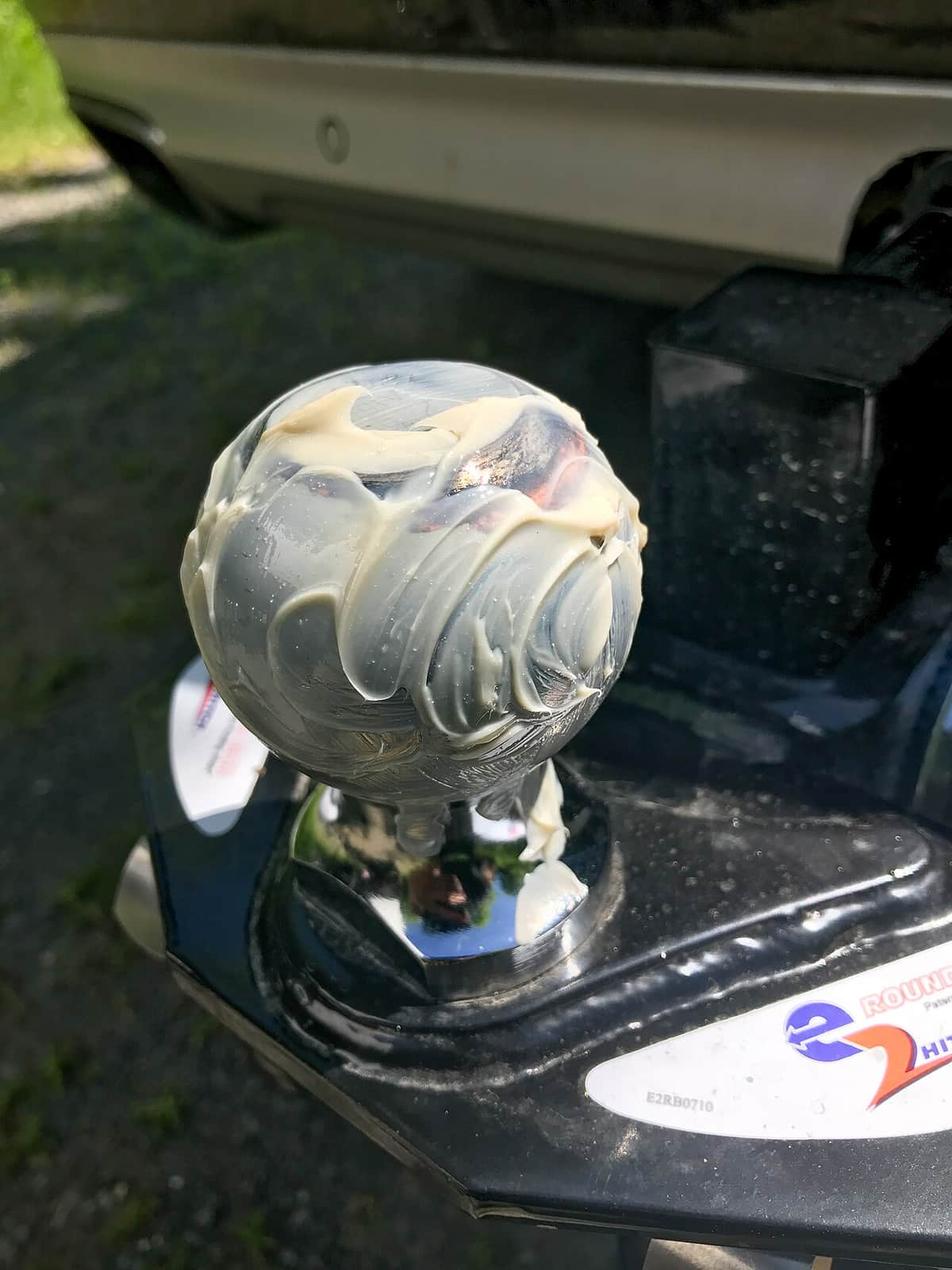
Hitch Ball Grease and Where It Belongs
Three places on a towing rig want grease and two emphatically do not. Getting that backwards is why some hitches squeal and others never do.
Disclosure: we earn a commission if you buy through the Amazon links on this page, at no extra cost to you. Commission never decides a verdict or a ranking position - read our editorial policy and affiliate disclosure.
Short answer
Grease the hitch ball itself and the coupler socket that rides on it, and grease a weight distribution head's spring bar sockets. Keep friction sway control faces, the receiver tube and the hitch pin dry - grease on a friction face destroys the resistance you paid for.
Most of the questions about hitch grease are really questions about noise. A towing rig makes several different sounds, they have different causes, and only some of them are a lubrication problem. Getting this right is worth a few minutes, because the standard response - spray everything - makes two of the three causes worse.
What to grease
- The hitch ball. The coupler socket turns and rocks on this ball every time you move. Dry steel on dry steel wears both parts and groans doing it. A general-purpose lithium or marine grease, wiped on, is the normal answer.
- The coupler socket. Same joint, other half. Worth cleaning out old grease and grit once a season rather than packing more on top.
- A weight distribution head's spring bar sockets. The bar ends rotate in these under load. Some heads have a grease fitting or an integrated lubrication design precisely because this is where the groaning comes from.
What to keep dry
- Friction sway control faces. This is the one that costs people real money. A friction sway bar, and the L-bracket faces on a four-point friction hitch, resist yaw by steel rubbing on steel. Grease them and they slide freely, which is the opposite of the function. Friction, dual cam and four-point systems all depend on this in different degrees.
- The receiver tube and the hitch pin. A light anti-seize on the pin is defensible if you live where things rust solid. Grease inside the tube collects grit and makes an abrasive paste, and it does nothing for the rattle - that is slop, and slop needs a shim.
- Dual cam contact faces. Follow the manufacturer's instruction here; cam systems are specific about it, and generic hitch advice does not transfer.
What to look for when the noise does not go away
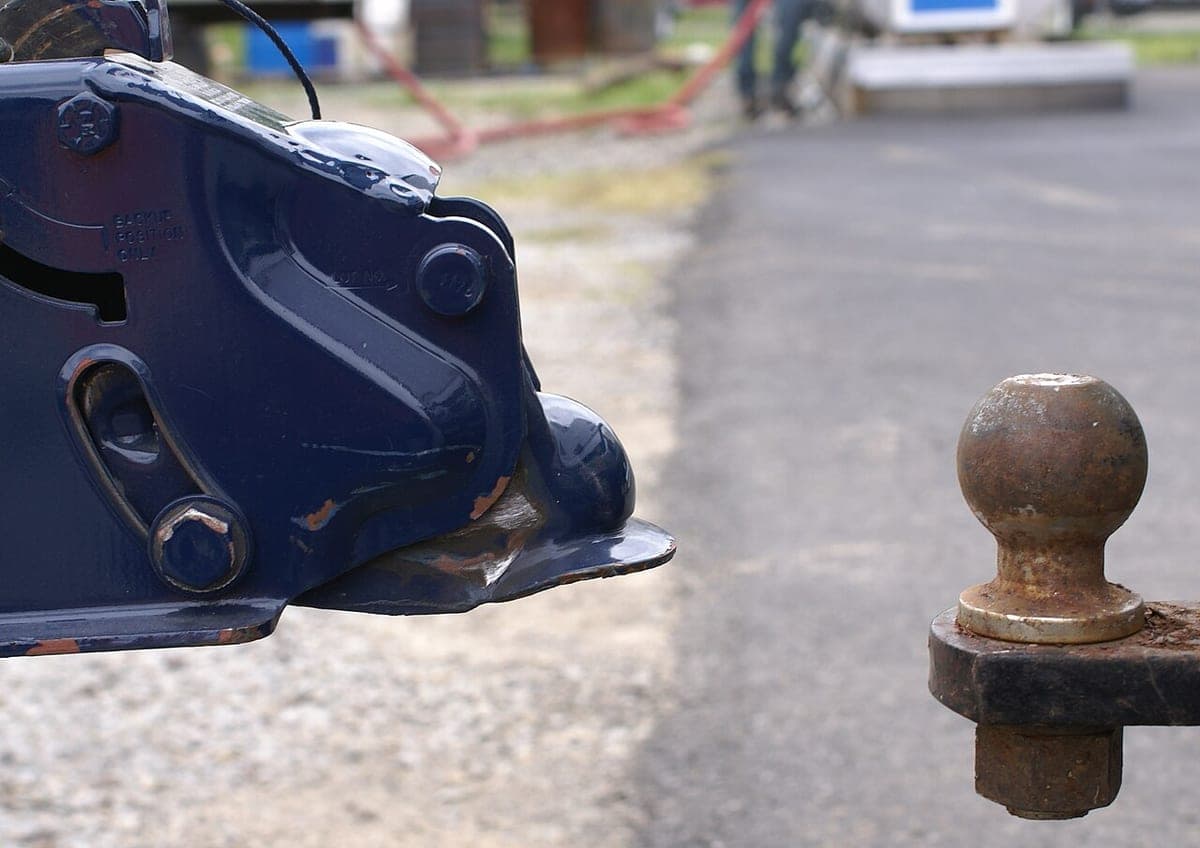
A greased ball that still squeals, or a coupler that still thumps, has usually told you something: the joint is worn beyond what lubrication covers. That is worth checking properly rather than re-greasing, because a loose coupler-to-ball fit is the failure mode with the worst consequences in towing.
The five-minute wear check
Wipe the ball clean
Old grease hides everything. Degrease it and look at bare metal.
Look for a flat spot or a band of wear
A ball wears on the forward face first. A visible flat, a step, or pitting from corrosion means replace it.
Check the stamped size and rating
Balls carry a diameter and a capacity stamp. Confirm both still suit your trailer - and that the diameter matches the coupler's own stamp.
Latch the coupler and lift the tongue
With the trailer unloaded, a correctly latched coupler should lift the ball mount with no vertical play. Play means the socket or the latch is worn.
Re-torque the ball nut
Ball nuts loosen. One published figure for a 1 in shank stainless ball is 250 ft-lb; use the figure for your own part number, and check it at the start of each season.
If any of those checks fails, the ball is a consumable and replacing it is the cheapest job on the whole rig. Ball sizes and what each one carries covers the sizing, and the picks below are the usual replacements.
Quick picks
Tap any row to jump to the full write-up. How these are chosen - and what we do and do not claim to know - is published in full on our research methodology page.
| # | Product | Best for | Our read | Price |
|---|---|---|---|---|
| 1 |  CURT 2 in Stainless Trailer Ball (1 in shank, 6,000 lb) If the ball is worn | Replacing a worn or wrong-size ball | Stainless, 6,000 lb, published 250 ft-lb torque | Check price on Amazon #ad Affiliate link - we publish no price; Amazon shows the current one |
| 2 |  CURT Loaded Ball Mount with 2 in Ball (2 in drop, 7,500 lb) If the mount is tired too | One trailer at a known height | 7,500 lb, ball already fitted and torqued | Check price on Amazon #ad Affiliate link - we publish no price; Amazon shows the current one |
| 3 |  CURT Anti-Rattle Hitch Pin and Shim (2 in receiver) If the noise is in the receiver | Killing receiver rattle | Takes the slop out of the tube | Check price on Amazon #ad Affiliate link - we publish no price; Amazon shows the current one |
1. If the ball is worn
CURT 2 in Stainless Trailer Ball (1 in shank, 6,000 lb)
CURT · Best for replacing a worn or wrong-size ball
A replacement 2 in ball on a 1 in shank, rated to 6,000 lb, with a published torque figure of 250 ft-lb. That torque number is the reason to buy a ball from a manufacturer that publishes specs: an under-torqued ball nut is a genuine failure mode.
Published specifications
What works
- Published torque specification, which many balls do not come with
- Stainless finish survives a boat ramp better than plain zinc
- Correct shank sizing is spelled out rather than assumed
What does not
- 6,000 lb ceiling is below what many 2 in couplers are rated to carry
- Needs a torque wrench to fit properly, which many people do not own
Skip it if
Not enough ball if your coupler is rated above 6,000 lb - match the ball to the coupler's rating, not to the hole in your mount.
#ad Affiliate link - we publish no price; Amazon shows the current one
Raw specifications: CURT’s own page. We earn nothing on that link.
2. If the mount is tired too
CURT Loaded Ball Mount with 2 in Ball (2 in drop, 7,500 lb)
CURT · Best for one trailer at a known height
A one-piece mount with the ball already fitted and torqued, rated to 7,500 lb gross and 750 lb tongue with a 2 in drop. Nothing adjusts, which is exactly why nothing rattles or works loose.
Published specifications
What works
- Arrives with the ball fitted, so there is no torque step to get wrong
- One piece means nothing to loosen or rattle
- Light enough to leave in the receiver or throw in a toolbox
What does not
- The 2 in drop is the only drop - measure before you buy
- 7,500 lb ceiling rules out heavier trailers
Skip it if
Useless on a lifted truck, where a 2 in drop will still leave the trailer nose-high and the weight on the rear axle of the trailer.
#ad Affiliate link - we publish no price; Amazon shows the current one
Raw specifications: CURT’s own page. We earn nothing on that link.
3. If the noise is in the receiver
CURT Anti-Rattle Hitch Pin and Shim (2 in receiver)
CURT · Best for killing receiver rattle
A pin plus a wedge shim that takes the slop out of the gap between a 2 in mount and a 2 in receiver. That gap is a manufacturing tolerance, not a fault, and this is the cheapest thing on the whole site that fixes a real, daily annoyance.
Published specifications
What works
- Removes the clunk over expansion joints for very little money
- Fits in a glovebox and transfers between vehicles
- No modification to the receiver or the mount
What does not
- Does nothing about rattle originating at the coupler or the sway bar
- Listed as superseded, so check the current item number
Skip it if
Not the fix if the noise is coming from a loose ball nut or a worn coupler - find the source first, because a shim will just mask it.
#ad Affiliate link - we publish no price; Amazon shows the current one
Raw specifications: CURT’s own page. We earn nothing on that link.
A seasonal routine that takes ten minutes
- Degrease and inspect the ball, then re-grease it and the coupler socket.
- Re-torque the ball nut to the manufacturer's published figure.
- Wipe grit out of the receiver tube - dry, no grease.
- Clean the friction faces on any sway control hardware with a solvent, and leave them dry.
- Grease the spring bar sockets if your weight distribution head calls for it.
- Check the safety chain hooks and the breakaway cable while you are down there.
Doing this before the first trip of the season catches the two things that actually strand people: a seized hitch pin and a worn coupler. Neither is expensive to fix in a driveway and both are miserable on a shoulder.
Key takeaways
- Grease the ball, the coupler socket and the spring bar sockets.
- Never grease friction sway control faces - it disables them.
- Keep the receiver tube dry; grit plus grease is an abrasive.
- Noise after greasing means wear, and a hitch ball is a consumable.
How we sourced this
Every figure on this page came from one of the following, each fetched while the page was written. Where a manufacturer or regulator does not publish a number, we say so rather than estimate it.
- CURT 2 in stainless trailer ball - published specifications including 250 ft-lb mounting torque (part 40083)
- CURT loaded ball mount, 2 in ball, 2 in drop - published specifications (part 45036)
- CURT anti-rattle hitch pin and shim - published specifications (part 22321)
- 49 CFR 393.70 - coupling devices and towing methods, including safety chain and cable arrangement
Common questions
- What kind of grease should I use on a hitch ball?
- A general-purpose lithium grease is the common choice, and a marine grease if the trailer sees water. The more important point is that it is grease rather than a penetrating spray - a thin oil washes off the ball within a few miles.
- Should I grease my weight distribution hitch?
- The spring bar sockets in the head, yes, and some heads include a lubrication system for exactly that. The friction surfaces that provide sway control, no. Follow your hitch's own manual, because the split differs between designs.
- Why does my hitch squeak even after greasing it?
- Usually a worn ball or coupler socket, or a dry weight distribution head rather than a dry ball. Degrease the ball and look for a flat spot; if the metal is stepped or pitted, lubrication will not quiet it again.
- Does grease stop hitch rattle?
- No. Rattle is clearance between the ball mount and the receiver tube. The fix is a shim or an anti-rattle pin that takes up the gap, not a lubricant that lets the parts move more easily.
More in Hitches, Receivers & Ball Mounts
Class, receiver size, ball diameter, drop. Four numbers decide whether your setup is right, and three of them are stamped on parts you already own.
Read next
Reference
Trailer Ball Sizes
The three standard ball diameters, how shank dimensions work, and why mounting torque is a specification rather than a suggestion.
Guide
Ball Mount vs Hitch Ball
What each part does, how their ratings interact, and the torque step that gets skipped when you buy them separately.
Guide
Hitch Pin Sizes
Pin diameters and lengths, the difference between clip and locking pins, and how anti-rattle pins work.
Best anti-rattle and lock
Hitch Locks & Anti-Rattle
Anti-rattle pins, receiver locks and coupler locks - what each one actually prevents and where each one fails.
Found something out of date, or a figure you can source better than we did? Corrections get read first. How we research explains how these pages are put together, and contact is one click away.