Trailer Sway & Sway Control
Why an Empty Trailer Sways More Than a Loaded One
Light is not the same as stable. An empty trailer has almost nothing holding its nose down and nothing damping its movement.
Disclosure: we earn a commission if you buy through the Amazon links on this page, at no extra cost to you. Commission never decides a verdict or a ranking position - read our editorial policy and affiliate disclosure.
Short answer
An empty trailer has very little absolute tongue weight and very little mass to damp a disturbance, so the same gust that barely moves a loaded trailer sets an empty one oscillating. The percentage may look acceptable while the actual pounds on the ball are tiny.
Percentages lie at low weights
The 10 to 15 percent rule is a ratio, and ratios behave oddly at the bottom of the scale. An empty 2,000 lb utility trailer at 10 percent carries 200 lb on the ball. That is a correct percentage and an almost negligible absolute force - easily overcome by a gust or a bow wave. The same trailer loaded to 5,000 lb with the same 10 percent is carrying 500 lb, and that force takes real energy to overcome.
So an empty trailer can be in spec and still feel nervous. That is not a contradiction; it is the limit of a percentage rule.
Why empty trailers are often also tail-heavy
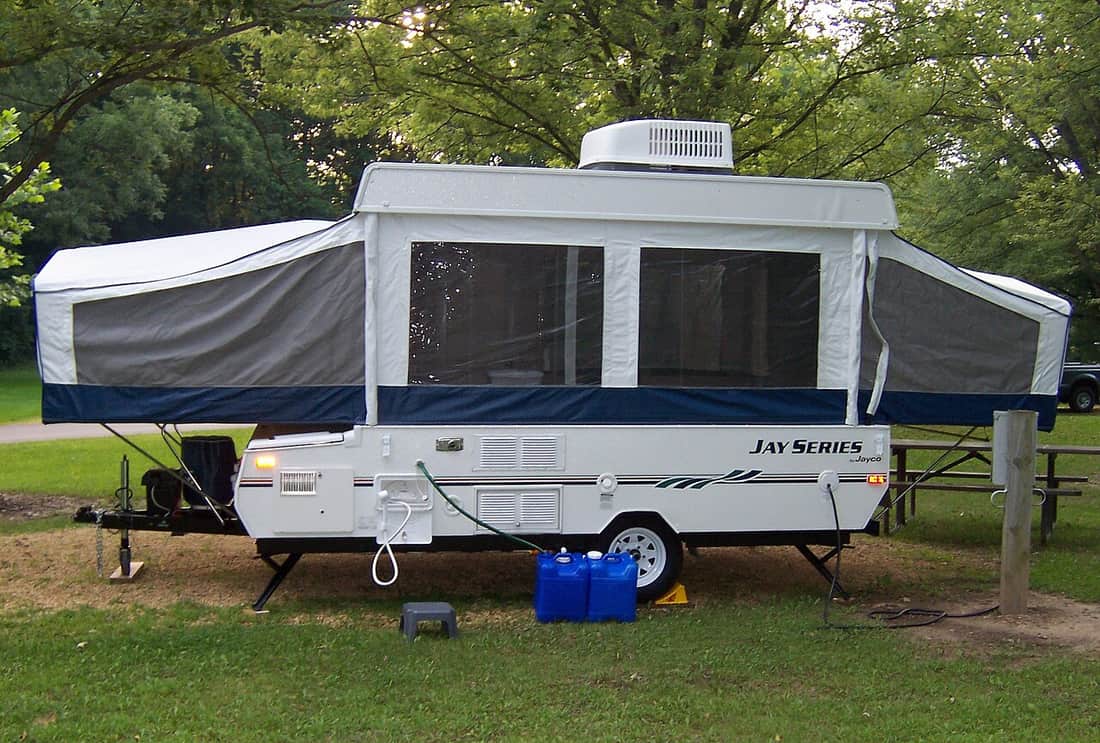
Most trailers carry permanent weight behind their axles - a rear door, a ramp, a spare tire carrier, a toolbox, a rear bumper. When the trailer is loaded, that fixed rear weight is a small fraction of the total. When it is empty, it is a large fraction, and the balance shifts backwards. Pop-ups and enclosed cargo trailers with heavy rear ramps are the clearest examples.
What to do about it
- Put the remaining load at the front. If you are returning with a few items, strap them ahead of the axles rather than wherever they fit.
- Carry ballast deliberately if the trailer is genuinely empty. A couple of sandbags or water containers strapped down ahead of the axles costs nothing and changes the behavior noticeably. Strap them - loose ballast is a projectile.
- Slow down. The sway threshold is lower on a light trailer, so the speed that was comfortable loaded may not be comfortable empty.
- Check the coupler and ball for wear. A worn coupler on a nearly-weightless tongue has more freedom to move than it does under load. Looseness you never notice loaded shows up empty.
- Keep the sway bar connected. If you run a friction bar, it is doing more for you empty than loaded, not less.
Quick picks
Tap any row to jump to the full write-up. How these are chosen - and what we do and do not claim to know - is published in full on our research methodology page.
| # | Product | Best for | Our read | Price |
|---|---|---|---|---|
| 1 |  CURT Sway Control Kit Right-sized fix | Light trailers that wander | Damping for a light trailer, adjustable | Check price on Amazon #ad Affiliate link - we publish no price; Amazon shows the current one |
| 2 |  Sherline Trailer Tongue Weight Scale Confirm the cause | Measuring tongue weight at home | Shows how little weight is really on the ball | Check price on Amazon #ad Affiliate link - we publish no price; Amazon shows the current one |
| 3 |  Camco Trailer Wheel Chocks Loading discipline | Every trailer, without exception | Chock before you load or unload, every time | Check price on Amazon #ad Affiliate link - we publish no price; Amazon shows the current one |
1. Right-sized fix
CURT Sway Control Kit
CURT · Best for light trailers that wander
A single friction bar between the trailer tongue and the ball mount, with adjustable tension. It damps yaw; it does not transfer load. On a light trailer that wanders a little it is the cheapest honest fix, and on a heavy one it is not enough on its own.
What works
- Simple, serviceable and easy to fit to an existing ball mount
- Tension is adjustable, so you can match it to the trailer
- Takes minutes to add to a setup you already own
What does not
- Must be disconnected before backing up tightly or in icy conditions
- Damps sway but does nothing about a tow vehicle that is squatting
Skip it if
The wrong answer if your truck sags at the back when the trailer is on - that is a load-distribution problem and a friction bar will not touch it.
#ad Affiliate link - we publish no price; Amazon shows the current one
Raw specifications: CURT’s own page. We earn nothing on that link.
2. Confirm the cause
Sherline Trailer Tongue Weight Scale
Sherline · Best for measuring tongue weight at home
A dedicated scale you sit under the coupler to read tongue weight directly, with no arithmetic and no trip to a weighbridge. It is the one tool on this site that turns the single most important towing number from a guess into a measurement.
We have not sourced a full specification table for this model from the manufacturer’s own site at a stable address. Rather than repeat figures we cannot cite, the assessment above is limited to what the design and the maker’s published description genuinely establish.
What works
- Direct reading, with no bathroom-scale-and-lever arithmetic
- Repeatable, so you can see what moving the load actually does
- Mechanical gauge with no batteries to be flat when you need it
What does not
- Must be used on level ground with the coupler at towing height
- Single-purpose tool that spends most of its life in a cupboard
Skip it if
Unnecessary if your hitch already has a built-in gauge, or if you have a public scale nearby and are happy to use it.
#ad Affiliate link - we publish no price; Amazon shows the current one
Raw specifications: Sherline’s own page. We earn nothing on that link.
3. Loading discipline
Camco Trailer Wheel Chocks
Camco · Best for every trailer, without exception
Chocks go in before you unhitch, every time. They are not an upgrade and they are not interesting; they are the thing standing between a parked trailer and a slow roll down a campground slope.
We have not sourced a full specification table for this model from the manufacturer’s own site at a stable address. Rather than repeat figures we cannot cite, the assessment above is limited to what the design and the maker’s published description genuinely establish.
What works
- Cheap insurance against the most preventable trailer accident there is
- Works on any trailer regardless of brakes or jack type
- Takes seconds and needs no setup
What does not
- Plastic chocks degrade in sun over several seasons
- Easy to leave behind at a site
Skip it if
There is no situation where you should skip chocks - if these do not suit your tire size, buy different ones rather than none.
#ad Affiliate link - we publish no price; Amazon shows the current one
Key takeaways
- A correct percentage can still be a tiny force when the trailer is light.
- Fixed rear weight - ramps, doors, spare carriers - dominates balance when the trailer is empty.
- Strapped ballast ahead of the axles is a legitimate, cheap fix for a genuinely empty trailer.
- Coupler and ball wear shows up empty because there is no load holding things in place.
How we sourced this
Every figure on this page came from one of the following, each fetched while the page was written. Where a manufacturer or regulator does not publish a number, we say so rather than estimate it.
Common questions
- Is it legal to add ballast to a trailer?
- Yes - it is cargo like anything else, and it must be secured. The constraint is your trailer's gross weight rating and your tow vehicle's payload, neither of which an empty trailer is anywhere near.
- Should I remove the sway bar when the trailer is empty?
- No. An empty trailer benefits more from damping, not less. The only reason to disconnect a friction bar is tight reversing or ice.
- Why does my utility trailer bounce as well as sway when empty?
- Trailer suspensions are sprung for their rated load. With nothing in the trailer, the springs are barely compressed and the trailer skips over bumps. That skipping unloads the tires momentarily, which makes the trailer easier to push sideways.
More in Trailer Sway & Sway Control
Sway is almost never a mystery. It comes down to tongue weight, load position or speed - and only one of those three costs money to fix.
Read next

Guide
Why Trailers Sway
The physics in plain terms, the three causes ranked by how often they are to blame, and how to tell which one you have.
Troubleshooting
Trailer Bouncing
Porpoising, chucking and axle hop told apart, with the fix for each and the one that gets misdiagnosed most often.

How to
Measuring Tongue Weight
Three methods for measuring tongue weight, what each one requires, and how to interpret the result against the 10-15 percent band.
Guide
Preventing Trailer Sway
The pre-trip loading and setup routine that stops sway starting, plus the habits that quietly cause it.
Found something out of date, or a figure you can source better than we did? Corrections get read first. How we research explains how these pages are put together, and contact is one click away.