Hitches, Receivers & Ball Mounts
What Is the Standard Trailer Hitch Ball Size?
There is a common size and there is your size. Buying on the first and assuming the second is how couplers come off balls.
Disclosure: we earn a commission if you buy through the Amazon links on this page, at no extra cost to you. Commission never decides a verdict or a ranking position - read our editorial policy and affiliate disclosure.
Short answer
Two inches is the standard trailer hitch ball size in the United States - it is the most common size by a wide margin and the one most rental and mid-size trailers use. It is not universal: 1-7/8 in is used on light trailers and 2-5/16 in on heavy ones, and the stamp on your coupler is what decides it.
Two different questions hide inside this search. One is what to expect when you borrow a trailer or buy a mount in advance, and for that, two inches is the right answer. The other is what to actually bolt on, and for that there is no standard at all - only what your coupler is marked for. Treating the first answer as the second is the single most dangerous mistake in this category.
What you will meet, by trailer type
| Trailer type | Most common ball | Why |
|---|---|---|
| Rental box and utility trailers | 2 in | Rental fleets standardize so one mount fits everything |
| Small utility and yard trailers | 1-7/8 in or 2 in | Light enough for the smaller coupler, often sold either way |
| Pop-up campers and small boats | 1-7/8 in or 2 in | Depends on weight rather than on category |
| Mid-size travel trailers and car haulers | 2 in | The weight band where 2 in is rated comfortably |
| Heavy travel trailers and equipment trailers | 2-5/16 in | Higher capacity at the same mount |
A guide to what is common, not a lookup for your trailer. Couplers within every category are sold in more than one size.
The reference chart with diameters, capacities and shank sizes lives on the full trailer ball sizes page. This page answers the narrower question people actually type: what is the usual one.
Why standard is not a specification
There is no single legal or regulatory trailer ball size. What exists is a market that converged on three diameters, and a labeling convention: every coupler carries its rated ball size stamped or cast into it, usually on the top face alongside a capacity figure. That stamp is the specification. The word standard describes what is common on a shelf, not what is correct on your trailer.
How to be certain in thirty seconds
- Read the coupler. Look at the top of the coupler on the trailer's A-frame. The size is stamped or cast there. If paint has filled it, a wire brush brings it back.
- If it is illegible, measure the throat. A tape across the inside of the coupler socket distinguishes the three sizes well enough to identify which one it is - the gaps between them are large relative to tape accuracy.
- Match the ball exactly. Not close, not the nearest you own. Exactly.
- Check the ball's own capacity. Diameter and rating are separate. A 2 in ball can be sold at several capacities, and it must meet or exceed your loaded trailer weight.
The two specifications people forget
The shank is the first. Below the ball is a threaded shank with its own diameter and length, and it has to match the hole in your ball mount and the mount's thickness. A 2 in ball is commonly sold on a 1 in shank, but not always, and a shank that is loose in the hole is a failure in progress.
Mounting torque is the second. Published trailer ball torque figures run into the hundreds of ft-lb - far beyond a wrench and a firm pull. If you do not own a torque wrench that reaches the figure in your ball's instructions, buy a mount with the ball already fitted and the step is gone. The same goes for the maintenance side: what to grease and what to keep dry covers the wear check that tells you when a ball is finished.
If the mismatch you are solving is the receiver tube rather than the ball, that is a different problem - receiver adapters exist but a correctly sized mount is nearly always the better answer.
Key takeaways
- Two inches is the most common trailer ball size in the US.
- Common is not the same as correct - the coupler stamp decides.
- A smaller ball latches in a larger coupler and can still come off.
- Diameter, capacity and shank size are three separate specifications.
- Mounting torque is a published figure in the hundreds of ft-lb.
How we sourced this
Every figure on this page came from one of the following, each fetched while the page was written. Where a manufacturer or regulator does not publish a number, we say so rather than estimate it.
- CURT 2 in stainless trailer ball - published specifications including 250 ft-lb mounting torque (part 40083)
- CURT loaded ball mount, 2 in ball, 2 in drop - published specifications (part 45036)
- CURT adjustable channel mount with dual ball - published specifications (part 45900)
- 49 CFR 393.70 - coupling devices and towing methods, including safety chain and cable arrangement
Common questions
- What is the most common trailer hitch ball size?
- Two inches. It covers most mid-size trailers, most rental trailers and most car haulers in the United States, which is why mounts and loaded ball mounts are sold in that size by default.
- What size ball does a U-Haul trailer use?
- Rental fleets standardize their couplers so that one mount fits across the fleet, and 2 in is the size they have settled on. Confirm it against the stamp on the coupler of the specific trailer you are given rather than assuming.
- Is there a legal standard trailer ball size?
- No. There is no single regulated diameter. What is regulated in practice is that the connection must be rated for the load, which is why couplers carry both a ball size and a capacity stamped into them.
- How do I tell a 1-7/8 in ball from a 2 in ball?
- By the size stamped on the ball itself or on its packaging, because the two are genuinely hard to distinguish by eye. If a ball is unmarked and you are unsure, replace it - the cost of a new ball is trivial next to the consequence of guessing.
More in Hitches, Receivers & Ball Mounts
Class, receiver size, ball diameter, drop. Four numbers decide whether your setup is right, and three of them are stamped on parts you already own.
Read next
Reference
Trailer Ball Sizes
The three standard ball diameters, how shank dimensions work, and why mounting torque is a specification rather than a suggestion.
Guide
Ball Mount vs Hitch Ball
What each part does, how their ratings interact, and the torque step that gets skipped when you buy them separately.
Best ball mount
Best Ball Mounts
Fixed, adjustable, stowing and scale-equipped mounts compared on drop range, capacity and how much they rattle.
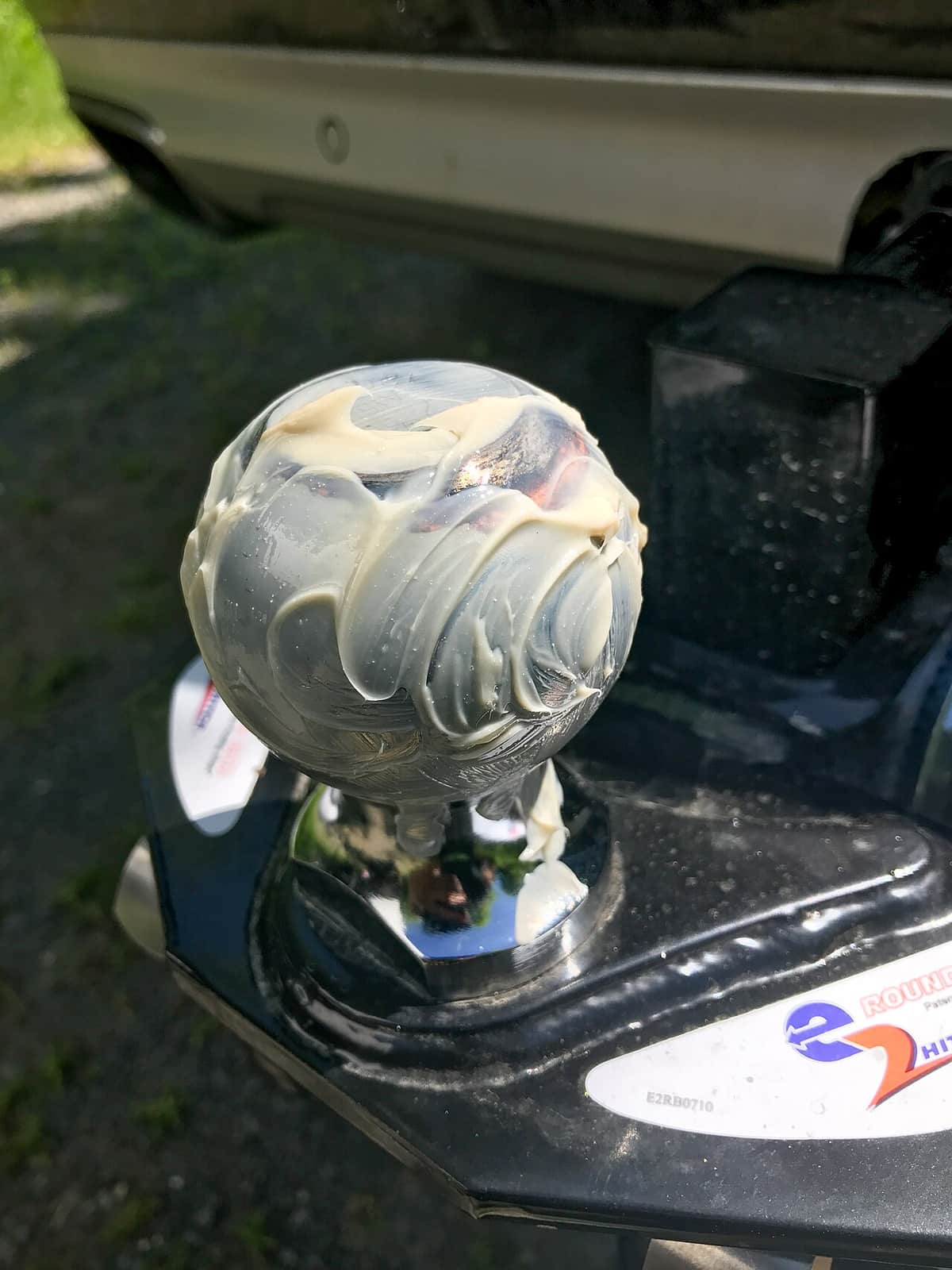
Guide
Hitch Ball Grease
What to grease on a hitch, what to keep bone dry, and why a ball that still squeals after greasing is telling you it is worn out.

Reference
Receiver Sizes Chart
Tube sizes, pin hole diameters, what fits what, and the derating that comes with a reducer sleeve.
Found something out of date, or a figure you can source better than we did? Corrections get read first. How we research explains how these pages are put together, and contact is one click away.