Trailer Sway & Sway Control
Why a Boat Trailer Fishtails, and How to Stop It
Boat trailers sway for one reason far more often than any other: the boat is sitting too far back on the bunks.
Disclosure: we earn a commission if you buy through the Amazon links on this page, at no extra cost to you. Commission never decides a verdict or a ranking position - read our editorial policy and affiliate disclosure.
Short answer
A fishtailing boat trailer almost always has too little tongue weight, because the boat has been winched up short or has slid back on the bunks. Move the boat forward until the tongue carries 10 to 15 percent of the loaded weight and the sway usually stops.
Boat trailers sway for the same underlying reason every trailer does - not enough weight on the ball - but they get there by a route no other trailer takes. The load is not bolted down. It sits on bunks or rollers and it can end up anywhere along them, which means a boat trailer's tongue weight changes every time the boat is loaded.
The loading cause, which is most of them
On a bunk trailer the boat should be winched forward until the bow eye is snug against the bow stop. It is common for a boat to end up an inch or several inches short of that, especially when the ramp is steep or the current is pushing. Every inch rearward moves load off the tongue and toward the axle, and a trailer whose load sits at or behind the axle will yaw at speed no matter what hardware is on the hitch.
Gear makes it worse in the same direction. Fuel in a rear tank, a kicker motor, batteries in the stern, coolers and anchors in the back of the cockpit all sit well behind the axle. Two people loading the same boat the same way can produce completely different tongue weights depending on where the heavy items went.
What to check, in order
- Bow eye against the bow stop. The simplest and most common fix. Re-winch it and look along the trailer from the side: the boat should sit square on the bunks, not hanging back.
- Tongue weight, measured. 10 to 15 percent of the loaded trailer weight. The measuring methods all work on a boat trailer, and the bathroom-scale lever method is enough to tell you whether you are near 5 percent or near 12.
- Where the heavy gear is. Fuel, batteries, kicker, anchor. Move what you can forward of the axle.
- Trailer tire pressure. Cold, to the sidewall figure, on both sides. A soft tire on one side introduces a steering input the trailer did not ask for, and boat trailer tires sit unused for months at a time.
- Towing attitude. A trailer towed nose-high shifts load rearward all over again. Measure the coupler height with the trailer level and buy the mount drop from the difference.
- Bunk and roller condition. A collapsed bunk or a seized roller lets the hull sit in a position it was never meant to.
Why boat trailers are a special case for hardware
The standard answer to sway on a travel trailer is a weight distribution hitch with integrated sway control. On a boat trailer that advice has to be qualified twice.
- Many boat trailer makers prohibit weight distribution hitches. The spring bar brackets clamp to an A-frame that was not designed for that load. Check the trailer manufacturer's instruction before you consider one, and treat a prohibition as final.
- Surge brake couplers complicate a friction sway bar. A friction bar runs between the trailer A-frame and the ball mount, and a surge actuator needs to slide. Confirm the sway bar's own instructions allow fitting to a surge coupler before buying one.
- Immersion is hard on friction hardware. Friction faces want to be clean and dry, which is not the life a boat trailer leads. Expect to clean and inspect them more often than a travel trailer owner would.
That is not a reason to rule hardware out, but it is a reason to fix the loading first. On a boat trailer the loading fix is free, it is usually the whole problem, and it takes five minutes at the ramp.
Quick picks
Tap any row to jump to the full write-up. How these are chosen - and what we do and do not claim to know - is published in full on our research methodology page.
| # | Product | Best for | Our read | Price |
|---|---|---|---|---|
| 1 |  Sherline Trailer Tongue Weight Scale Check this first | Measuring tongue weight at home | Tells you whether the boat is too far back | Check price on Amazon #ad Affiliate link - we publish no price; Amazon shows the current one |
| 2 |  CURT Adjustable Channel Mount with Dual Ball (2 in shank, 6 in drop) If it tows nose-high | Garages with several trailers | Two ball sizes and 6 in of drop to get level | Check price on Amazon #ad Affiliate link - we publish no price; Amazon shows the current one |
| 3 |  CURT Sway Control Kit If it still wanders | Light trailers that wander | Adjustable friction bar, 14 lb, bolt-on | Check price on Amazon #ad Affiliate link - we publish no price; Amazon shows the current one |
1. Check this first
Sherline Trailer Tongue Weight Scale
Sherline · Best for measuring tongue weight at home
A dedicated scale you sit under the coupler to read tongue weight directly, with no arithmetic and no trip to a weighbridge. It is the one tool on this site that turns the single most important towing number from a guess into a measurement.
We have not sourced a full specification table for this model from the manufacturer’s own site at a stable address. Rather than repeat figures we cannot cite, the assessment above is limited to what the design and the maker’s published description genuinely establish.
What works
- Direct reading, with no bathroom-scale-and-lever arithmetic
- Repeatable, so you can see what moving the load actually does
- Mechanical gauge with no batteries to be flat when you need it
What does not
- Must be used on level ground with the coupler at towing height
- Single-purpose tool that spends most of its life in a cupboard
Skip it if
Unnecessary if your hitch already has a built-in gauge, or if you have a public scale nearby and are happy to use it.
#ad Affiliate link - we publish no price; Amazon shows the current one
Raw specifications: Sherline’s own page. We earn nothing on that link.
2. If it tows nose-high
CURT Adjustable Channel Mount with Dual Ball (2 in shank, 6 in drop)
CURT · Best for garages with several trailers
One mount that covers two ball sizes and a range of heights, which is the answer when the garage contains a boat trailer, a utility trailer and a camper that all sit at different heights. Capacity drops to the lower-rated ball you are actually using.
Published specifications
What works
- Two ball sizes and a height range in a single mount
- Flipping it gives rise as well as drop
- Rated to 14,000 lb on the larger ball
What does not
- Heavy, and more joints means more places for rattle to start
- The pins and bolts need checking for torque, unlike a one-piece mount
Skip it if
Pointless if you own one trailer and tow it with one truck - a fixed mount at the right height is lighter, quieter and cheaper.
#ad Affiliate link - we publish no price; Amazon shows the current one
Raw specifications: CURT’s own page. We earn nothing on that link.
3. If it still wanders
CURT Sway Control Kit
CURT · Best for light trailers that wander
A single friction bar between the trailer tongue and the ball mount, with adjustable tension. It damps yaw; it does not transfer load. On a light trailer that wanders a little it is the cheapest honest fix, and on a heavy one it is not enough on its own.
What works
- Simple, serviceable and easy to fit to an existing ball mount
- Tension is adjustable, so you can match it to the trailer
- Takes minutes to add to a setup you already own
What does not
- Must be disconnected before backing up tightly or in icy conditions
- Damps sway but does nothing about a tow vehicle that is squatting
Skip it if
The wrong answer if your truck sags at the back when the trailer is on - that is a load-distribution problem and a friction bar will not touch it.
#ad Affiliate link - we publish no price; Amazon shows the current one
Raw specifications: CURT’s own page. We earn nothing on that link.
The empty trailer on the way to the ramp
An unloaded boat trailer is light, stiffly sprung and has almost nothing on the tongue, which is a recipe for wandering at highway speed. That is normal behavior for an empty trailer rather than a fault, and the reasons an empty trailer sways more are worth reading if the outbound trip is the part that unsettles you. Lower speed is the practical answer; there is not much weight to redistribute.
If the sway persists with the boat correctly positioned, measured tongue weight in the 10 to 15 percent band and tires at pressure, then it is worth looking at the broader causes - the three real causes of trailer sway covers axle position, trailer length and tow vehicle wheelbase, all of which apply to boats too.
Key takeaways
- Winch the boat fully forward against the bow stop before anything else.
- Target 10 to 15 percent of loaded weight on the tongue, measured.
- Move fuel, batteries and the kicker forward of the axle where you can.
- Check the trailer maker's position on weight distribution hitches before buying one.
How we sourced this
Every figure on this page came from one of the following, each fetched while the page was written. Where a manufacturer or regulator does not publish a number, we say so rather than estimate it.
Common questions
- How much tongue weight should a boat trailer have?
- The same 10 to 15 percent of loaded trailer weight that applies to any conventional trailer. Boat trailers often end up well below that because the boat sits too far back, which is exactly why they fishtail.
- Can I use a weight distribution hitch on a boat trailer?
- Only if the trailer manufacturer permits it. A number of boat trailer makers prohibit spring bars because the A-frame is not built to take bracket loads. Their instruction overrides general towing advice.
- Does a sway bar work with surge brakes?
- Sometimes, and sometimes not. A surge actuator has to be free to slide, and some friction sway bars interfere with that. Check the sway control manufacturer's own instructions for surge-brake compatibility before fitting one.
- Why does my boat trailer only sway when passed by a truck?
- A passing truck pushes air at the side of the trailer and then pulls it back, which is a yaw input. A trailer with correct tongue weight absorbs that and settles; one with too little tongue weight starts oscillating. The pass is the trigger, not the cause.
More in Trailer Sway & Sway Control
Sway is almost never a mystery. It comes down to tongue weight, load position or speed - and only one of those three costs money to fix.
Read next

Guide
Why Trailers Sway
The physics in plain terms, the three causes ranked by how often they are to blame, and how to tell which one you have.

Troubleshooting
Trailer Fishtailing
What makes a mild wobble escalate into a full fishtail, how to end an episode without making it worse, and what to change afterwards.

How to
Measuring Tongue Weight
Three methods for measuring tongue weight, what each one requires, and how to interpret the result against the 10-15 percent band.
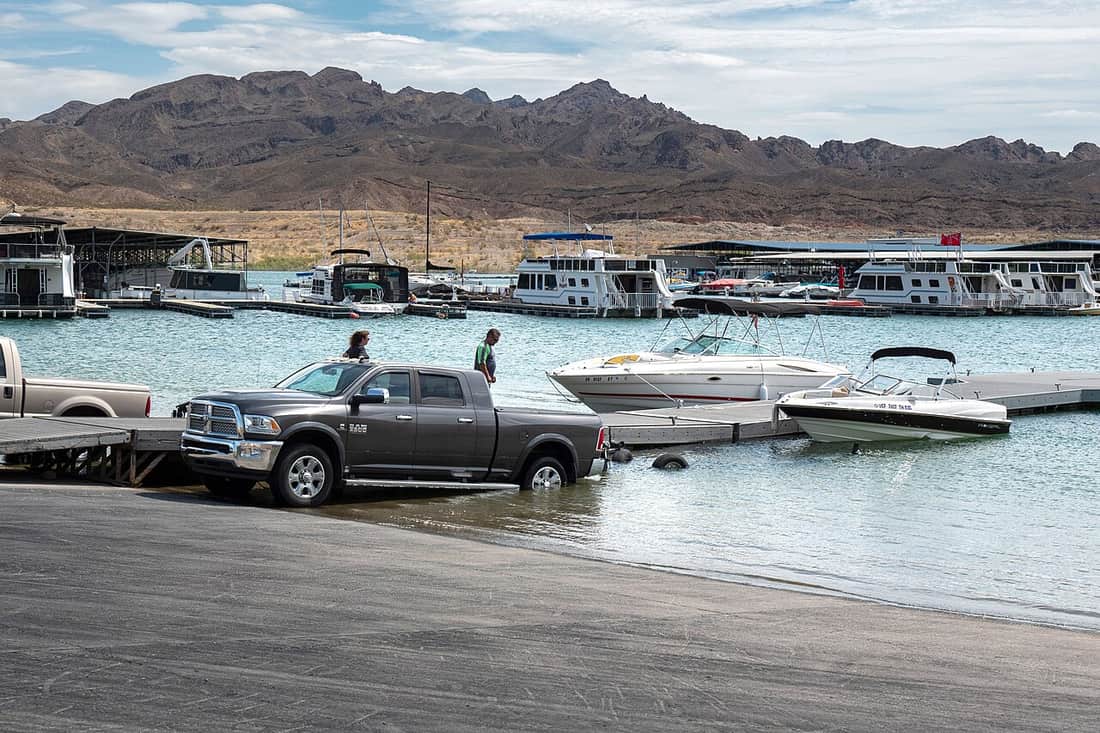
Best boat trailer hardware
Best Hitch for a Boat Trailer
What to buy for a boat trailer specifically: corrosion-resistant ball hardware, the surge-brake adapter nobody mentions, and lights rated for immersion.

Guide
First Time Towing a Boat
A first-timer's sequence for towing a boat: hitching, the ramp, launching and recovery, and the hardware that makes each step less eventful.
Found something out of date, or a figure you can source better than we did? Corrections get read first. How we research explains how these pages are put together, and contact is one click away.