Towing Capacity, Tongue Weight & Setup
Winter Towing: What Changes and What to Check
Nothing about towing gets easier below freezing. The useful part is knowing exactly which things get harder, and by how much.

Disclosure: we earn a commission if you buy through the Amazon links on this page, at no extra cost to you. Commission never decides a verdict or a ranking position - read our editorial policy and affiliate disclosure.
Short answer
Cold weather costs you tire pressure, battery capacity and grip, and it lengthens every stopping distance. Before a winter trip, set tire pressures cold to the sidewall figure, load-test the breakaway battery, re-set the brake controller gain lower, and allow far more following distance.
Winter towing is not a different skill so much as the same skill with the margins removed. Everything that was forgiving in July - a slightly soft tire, a breakaway battery nobody has checked, a trailer loaded a little light on the tongue - stops being forgiving when the surface has less grip and the stopping distances double. The useful approach is to go through the rig component by component and ask what the cold does to each one.
What actually changes when it gets cold
| What changes | Why | What to do about it |
|---|---|---|
| Tire pressure falls | Air contracts as temperature drops | Check cold, set to the sidewall figure, and re-check on the first cold morning of a trip |
| Battery capacity falls | Chemical reactions slow in the cold | Load-test the breakaway battery rather than trusting that it looks fine |
| Grip falls, often invisibly | Ice forms on bridges and shaded curves first | More following distance, gentler inputs, lower speed |
| Trailer brakes can lock sooner | Less available grip at the trailer tires | Lower the brake controller gain and re-set it on the surface you are driving |
| Grease stiffens | Cold thickens lubricant in hubs and on the ball | Service bearings before the season, not during it |
| Salt and brine attack everything | Road treatment is corrosive and gets everywhere | Rinse the underside, connector, chains and coupler after every trip |
Tire pressure figures come from the tire sidewall and the vehicle placard; we publish no vehicle-specific numbers. See 49 CFR 571.110 for what the placard is required to carry.
The pre-trip checks that matter most in the cold
Before a winter trip
Set every tire cold
Tow vehicle and trailer, including the spares. Cold means before driving, not after. Trailer tires sit unused for months and lose pressure quietly.
Load-test the breakaway battery
Not a voltage reading - a load test. A battery that shows full voltage and collapses under load is the normal failure, and cold brings it forward. This is the single most-skipped winter check.
Pull the breakaway pin, briefly, with the trailer chocked
The trailer brakes should apply. Reset the pin afterward. If nothing happens, the system is not protecting you and it needs fixing before the trip, not after.
Check the chains, hooks and coupler
Latch the coupler and lift the tongue with the jack. If the trailer lifts the ball mount, it is latched. Chains crossed under the tongue, with enough slack to turn but not to drag.
Walk the lights with someone watching
Short daylight means you will be running lights for most of the trip. A corroded ground is the usual cause and the connector is where salt does its work.
Measure or confirm your tongue weight
10 to 15 percent of loaded trailer weight. A trailer that was marginal in summer is a trailer that will find the edge of grip in winter. How to balance a trailer covers what to move if the number is low.
Lower the brake controller gain
Then re-set it properly on a quiet road at low speed. The summer setting will lock the trailer wheels on a cold, slick surface.
Clear snow and ice off the trailer
Roof, lights, reflectors and plate. A sheet of ice coming off a trailer roof at speed is a hazard to the vehicle behind you.
Setting brake gain for a slick surface
Brake controller gain is a setting for a load and a surface, not a number you set once and own forever. On dry pavement you raise gain until the trailer brakes just lock briefly under manual override, then back it off. On a cold, wet or icy surface that same setting locks the trailer wheels far sooner, and locked trailer wheels are exactly how a trailer starts to come around.
Start lower than your summer figure, then re-set it with the manual override on a quiet stretch at low speed, on the surface you are actually driving on. The full gain procedure is worth re-reading at the start of every winter.
Driving technique that actually helps
- Double or triple the following distance you would use unloaded. Stopping distance grows with weight and again with reduced grip, and the two compound rather than add.
- Brake early, gently and in a straight line. Braking in a curve asks the same tires to do two things at once, and in winter there is not enough grip for both.
- Treat bridges, overpasses and shaded bends as ice. They freeze first and thaw last, and they are exactly where a long rig has least room to recover.
- Avoid stopping on an upgrade if you can. Getting a loaded rig moving again on a slick incline is much harder than keeping it moving.
- Give yourself a bigger gap for lane changes. A wider trailer plus a salted, spray-covered mirror is less visibility than you are used to. Clean the mirrors at every stop.
- Slow down well before you think you need to. Every winter towing incident reads the same way afterward: the speed was fine until it suddenly was not.
What to look for in cold-weather gear
- Chocks that grip, in a size that suits your tires. A plastic chock on a packed-ice pad is doing less than you think. Use two, on both sides where the ground is sloped, and put them in before unhitching rather than after.
- A breakaway kit with a matched battery and charger. The switch is simple and reliable; the battery is the consumable, and cold is what exposes it. Attach the cable to the vehicle itself, never to the safety chains.
- Safety chains rated at or above the trailer's gross weight. Hardware-store chain of unknown grade is the wrong economy. Hooks with latches stay put on rough, frozen surfaces where unlatched hooks can bounce free.
- A way to measure tongue weight at home. Winter is the wrong season to find out that your trailer sits at 7 percent on the ball. What tongue weight is and why it matters explains the band.
Quick picks
Tap any row to jump to the full write-up. How these are chosen - and what we do and do not claim to know - is published in full on our research methodology page.
| # | Product | Best for | Our read | Price |
|---|---|---|---|---|
| 1 |  Camco Trailer Wheel Chocks Non-negotiable | Every trailer, without exception | Chocks before unhitching, more so on a frozen slope | Check price on Amazon #ad Affiliate link - we publish no price; Amazon shows the current one |
| 2 |  CURT Trailer Breakaway Kit with Battery Test this first | Braked trailers, where required | The battery cold weather quietly finishes off | Check price on Amazon #ad Affiliate link - we publish no price; Amazon shows the current one |
| 3 |  CURT Safety Chain Assembly with Hooks Replace if worn | Replacing worn or unrated chains | Rated chain and hooks, crossed under the tongue | Check price on Amazon #ad Affiliate link - we publish no price; Amazon shows the current one |
| 4 |  Sherline Trailer Tongue Weight Scale Loading discipline | Measuring tongue weight at home | Low tongue weight is worse on a slick road | Check price on Amazon #ad Affiliate link - we publish no price; Amazon shows the current one |
1. Non-negotiable
Camco Trailer Wheel Chocks
Camco · Best for every trailer, without exception
Chocks go in before you unhitch, every time. They are not an upgrade and they are not interesting; they are the thing standing between a parked trailer and a slow roll down a campground slope.
We have not sourced a full specification table for this model from the manufacturer’s own site at a stable address. Rather than repeat figures we cannot cite, the assessment above is limited to what the design and the maker’s published description genuinely establish.
What works
- Cheap insurance against the most preventable trailer accident there is
- Works on any trailer regardless of brakes or jack type
- Takes seconds and needs no setup
What does not
- Plastic chocks degrade in sun over several seasons
- Easy to leave behind at a site
Skip it if
There is no situation where you should skip chocks - if these do not suit your tire size, buy different ones rather than none.
#ad Affiliate link - we publish no price; Amazon shows the current one
2. Test this first
CURT Trailer Breakaway Kit with Battery
CURT · Best for braked trailers, where required
The switch and battery that apply the trailer's electric brakes if the trailer separates from the tow vehicle. Most states require it on braked trailers above a weight threshold, and the battery is the part everyone forgets to test.
We have not sourced a full specification table for this model from the manufacturer’s own site at a stable address. Rather than repeat figures we cannot cite, the assessment above is limited to what the design and the maker’s published description genuinely establish.
What works
- Applies the trailer brakes automatically in a separation
- Sold as a complete kit, so the battery and charger match the switch
- Addresses a legal requirement in most states for braked trailers
What does not
- The battery degrades silently and needs periodic load testing
- Cable must be attached to the vehicle, not to the safety chains
Skip it if
Not applicable to a trailer with no electric brakes - check what your trailer actually has before buying.
#ad Affiliate link - we publish no price; Amazon shows the current one
Raw specifications: CURT’s own page. We earn nothing on that link.
3. Replace if worn
CURT Safety Chain Assembly with Hooks
CURT · Best for replacing worn or unrated chains
Replacement safety chains with rated hooks. Two things decide whether chains do their job: the rating has to meet or exceed the trailer's gross weight, and they have to be crossed under the coupler so they cradle it if the ball lets go.
We have not sourced a full specification table for this model from the manufacturer’s own site at a stable address. Rather than repeat figures we cannot cite, the assessment above is limited to what the design and the maker’s published description genuinely establish.
What works
- Rated assemblies, rather than hardware-store chain of unknown grade
- Hooks sized to engage a receiver loop properly
- Cheap relative to what they are insuring against
What does not
- Length must be right - too long drags, too short binds in turns
- Hooks without latches can bounce off on rough surfaces
Skip it if
Do not buy a set rated below your trailer's gross weight to save money - that is the one specification on the whole part that matters.
#ad Affiliate link - we publish no price; Amazon shows the current one
Raw specifications: CURT’s own page. We earn nothing on that link.
4. Loading discipline
Sherline Trailer Tongue Weight Scale
Sherline · Best for measuring tongue weight at home
A dedicated scale you sit under the coupler to read tongue weight directly, with no arithmetic and no trip to a weighbridge. It is the one tool on this site that turns the single most important towing number from a guess into a measurement.
We have not sourced a full specification table for this model from the manufacturer’s own site at a stable address. Rather than repeat figures we cannot cite, the assessment above is limited to what the design and the maker’s published description genuinely establish.
What works
- Direct reading, with no bathroom-scale-and-lever arithmetic
- Repeatable, so you can see what moving the load actually does
- Mechanical gauge with no batteries to be flat when you need it
What does not
- Must be used on level ground with the coupler at towing height
- Single-purpose tool that spends most of its life in a cupboard
Skip it if
Unnecessary if your hitch already has a built-in gauge, or if you have a public scale nearby and are happy to use it.
#ad Affiliate link - we publish no price; Amazon shows the current one
Raw specifications: Sherline’s own page. We earn nothing on that link.
After every winter trip
- Rinse the underside, chains, coupler, ball and connector with fresh water. Road brine does not stop working when you get home.
- Dry and protect the electrical connector. Corrosion in a 7-way is the most common winter trailer fault and it starts with salt spray sitting in the pins.
- Re-grease the ball and coupler socket once everything is dry. What to grease and what to keep dry matters here, because grease on a friction sway control face disables it.
- Put the breakaway battery on charge. It will not recover on its own over a cold month in a driveway.
- Check the hubs for heat at your first stop on the next trip. A hub noticeably hotter than its partner is a bearing telling you something.
None of this is difficult and most of it takes minutes. The reason to make it a routine is that winter removes the margin that lets an un-serviced rig get away with things in summer - and the places it catches people out are shoulders, ramps and bridges, which are the worst places to find out.
Key takeaways
- Set every tire cold, including both spares, before each winter trip.
- Load-test the breakaway battery - cold is what exposes a weak one.
- Lower the brake controller gain and re-set it on the surface you are driving.
- Rinse the salt off the underside, connector and coupler after every trip.
How we sourced this
Every figure on this page came from one of the following, each fetched while the page was written. Where a manufacturer or regulator does not publish a number, we say so rather than estimate it.
- 49 CFR 571.110 (FMVSS 110) - vehicle placard, including the required "combined weight of occupants and cargo" statement
- 49 CFR 393.70 - coupling devices and towing methods, including safety chain and cable arrangement
- 49 CFR 571.108 (FMVSS 108) - lamps, reflective devices and associated equipment
- 49 CFR 567.4 - certification label content, including Gross Vehicle Weight Rating and Gross Axle Weight Rating
Common questions
- Should I lower my brake controller gain in winter?
- Yes, as a starting point, then re-set it properly with the manual override at low speed on the surface you are driving. A setting that was right on dry pavement will lock the trailer wheels on a cold, slick road, and locked trailer wheels are how a trailer starts to come around.
- Do trailer tires lose pressure in cold weather?
- Yes - air contracts as temperature falls, so a tire set in warm weather reads low on a cold morning. Check and set cold, to the figure on the tire sidewall and the vehicle placard, and re-check on the first cold day of a trip.
- Is a weight distribution hitch more important in winter?
- The reasons to fit one do not change - measured tongue weight against the receiver's weight-carrying rating, and whether the front of the tow vehicle rises. What changes is the cost of getting it wrong, because an unloaded front axle means less steering grip exactly when there is less grip available.
- How do I stop my trailer connector corroding over winter?
- Rinse it with fresh water after salted roads, dry it, and keep it covered when the trailer is parked. Corrosion in the pins is the most common winter trailer electrical fault, and it usually shows up as intermittent lights rather than as an obvious failure.
- Can I tow with snow on the trailer roof?
- Clear it first. A sheet of ice or a slab of snow leaving a trailer roof at highway speed is a hazard to whoever is behind you, and in many states you are responsible for load and debris coming off your vehicle.
More in Towing Capacity, Tongue Weight & Setup
The number in the brochure is not the number that limits you. The one that does is on a sticker inside your driver's door.
Read next
Guide
How to Balance a Trailer
Loading a trailer so it tows straight: the 60/40 rule, where heavy items belong, and how to confirm the result with a measurement.
Guide
Chains and Breakaway Cables
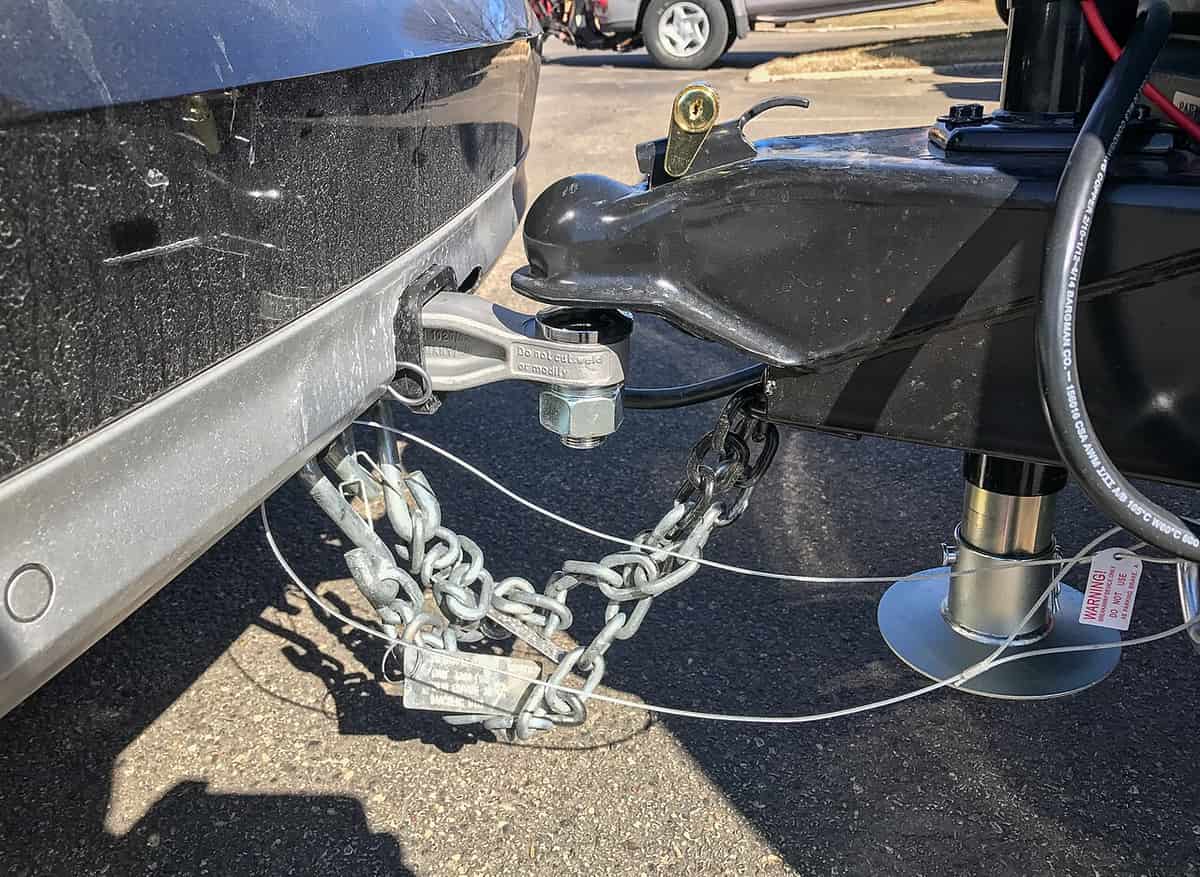
Chain rating and arrangement, breakaway switch wiring, and the maintenance step that decides whether either one works.
How to
Adjusting Brake Gain
The empirical gain procedure, how to read under- and over-braking, and the loads that make a reset necessary.
How to
How to Hook Up a Trailer
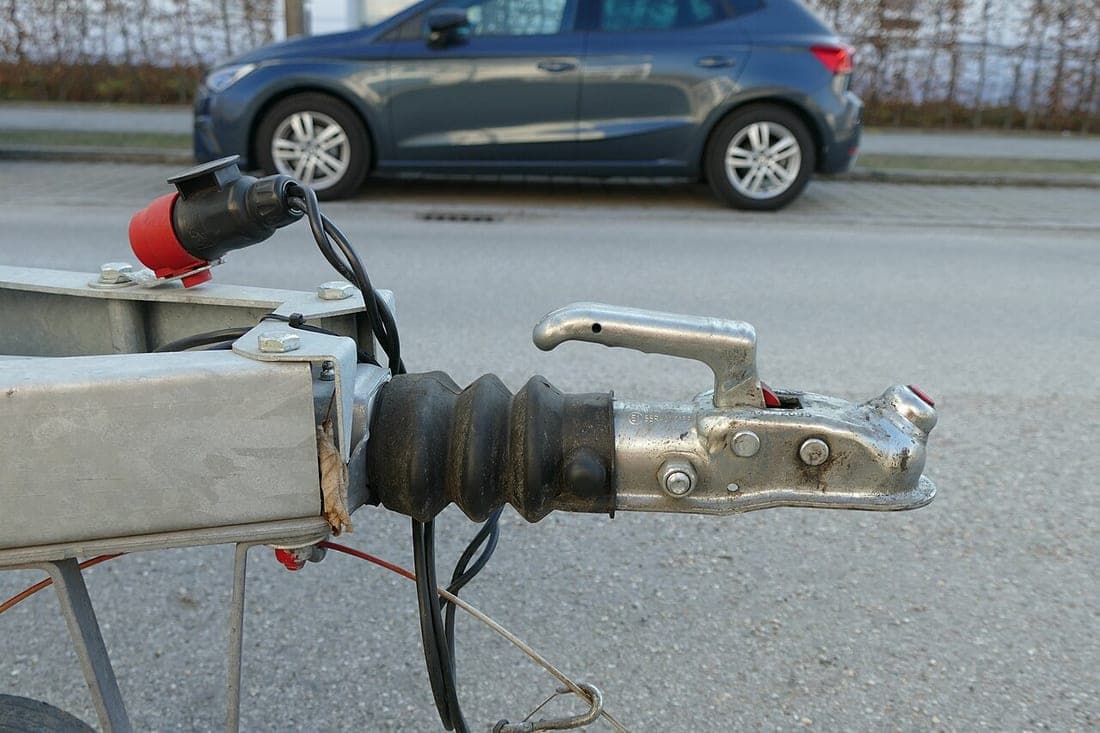
The full hitching sequence, why chains cross, where the breakaway cable goes, and what to check before you move.
Best SUV hitch hardware
Best Hitch Setup for an SUV
What to buy for an SUV receiver - mounts, balls, wiring and security - plus the three ratings that decide what the vehicle can actually pull.
Found something out of date, or a figure you can source better than we did? Corrections get read first. How we research explains how these pages are put together, and contact is one click away.